Designers: a user manual. Motivation, problems, solutions
I studied industrial design at the Architectural Academy and wanted to work in book graphics. Then those plans went belly up, I accidentally became one of the first three web designers in Yekaterinburg, and my world turned upside down.
I studied industrial design at the Architectural Academy and wanted to work in book graphics. But one day those plans went belly up, and I became — it just happened — one of the first three web designers in Yekaterinburg. My world turned upside down, and I realized that design is a completely different activity from what I’d thought before. That was 28 years ago. I’ve changed several design professions, learned to work as an art director, and then grew several art directors.
All these years we’ve had to say the same things over and over about what we consider design to be. Sometimes I start thinking that everything I’m going to say below is obvious anyway. And then some new discussion happens and it turns out that no, it isn’t obvious. So here are some of the axioms we start from when we make design. Maybe they’ll be useful to you too.
What is design? Who are designers at JetStyle?
Different studios mean different things by design and specialize in different aspects of it. At JetStyle we do interaction design. Because we think that designing how people interact is the central part of any digital product. That means that from our point of view, designers are not artists. That design is not self-expression, but engineering creativity. And that there are no criteria for design quality other than whether it solves the communication task or not. All the artistic devices and words of the expressive language are good exactly to the extent that they help people achieve their goals.
And what do we do with beauty, emotion, aesthetics? Does beautiful design really have no advantages, all else being equal, over design that’s usable but functional? Why do we even hire people with artistic taste as designers? Why did I study an artistic discipline myself?
Without going into detail, “beautiful”, “aesthetic”, “correct”, “good” are words that have no meaning outside the context of a goal. But at the same time, in order to make statements and be understood not only on the rational level but on the emotional one, you need a wide visual literacy, you need to understand how perception works, you need to be able to read the cultural code and speak in it. But yes, we really do think that there is no beauty or correctness that’s the same for everyone.
What brings a designer joy? What is the designer’s high?
I haven’t been supposed to do design for a long time, but sometimes I still smuggle some in, because honestly, I like designing more than managing. If you’ve tried it, you know that moment when you open Figma and start bringing some world into being, and you understand that a product will come out of this and people will start behaving differently. You disappear into the process like into a computer game — bam, and it’s the day after tomorrow. Only you didn’t just play. You also made some thing that at the moment you finish seems awesome to you. It’s a very specific and pure high. You hit flow. And there is no such joy at all in a manager’s work — the high there is a completely different one.
A recipe for designer motivation
If we’re talking about a designer’s motivation, the recipe is simple:
- Teach the designer to enjoy being in flow.
- Give them tasks capable of gripping them completely.
- If the designer finds it hard to see what’s interesting in a task, help them understand where the challenge is (this, by the way, is the hardest part, I think).
- Don’t distract them from work when they’re on a roll.
- Be glad about their successes.
- Help them get out of a dead end when they land in one.
Here the simple part of the recipe ends, and the hard part begins:
- Bring the designer tasks from their zone of proximal development. The difficulty is that you have to get those tasks from somewhere. And that’s a question not so much of raising a designer as of sales, and a completely different article.
- Make sure the designer sees how the result of their work gets used.
If you sum all this up, the designer’s high is that a designer can embody a vision “with these very hands” — create artifacts that will change people’s lives. If you learn to get a high from that, if you manage to fit that vision into the plans of the team / client / business, then as far as I’m concerned there are no particular problems with motivation. Personally it’s of course much easier for me than for a plain designer. I have a cheat — I’m not only a designer but also the product director and the company director, so when I draw pictures they have a much better chance of getting built.
Design that changes the world
And one more thing. There’s this phrase: “We work to make the world a better place.” And everything about it is very ambiguous. It’s very hard to believe, because in most cases it’s a lie, since usually you can’t see any particular connection between what we do and how the world changes. But if you allow yourself to understand that changing life for the better isn’t a sacred duty or marketing bullshit but a selfish designer’s desire (we just like seeing people use the interfaces we made and thank us for them), then it becomes clear that this changing of the world and the gratitude that comes with it is the highest-octane designer fuel. It’s just that you can’t always arrange it. I’d be lying if I said that we get it in most cases. We don’t.
On the other hand, in the designer’s seat you have a pile of ways to grab that fuel for yourself. You just have to twig that you’re designing not interfaces but a product. And to sell that vision to the team. True, in the end you’ll be called not a designer but a product manager. It’s a fairly mutant path into product, I have to say, but I like it.
What else motivates a designer?
Types of work motivation
I have an article about group motivation. Every now and then I run trainings on this topic. In particular, I go through the six motivations in detail.
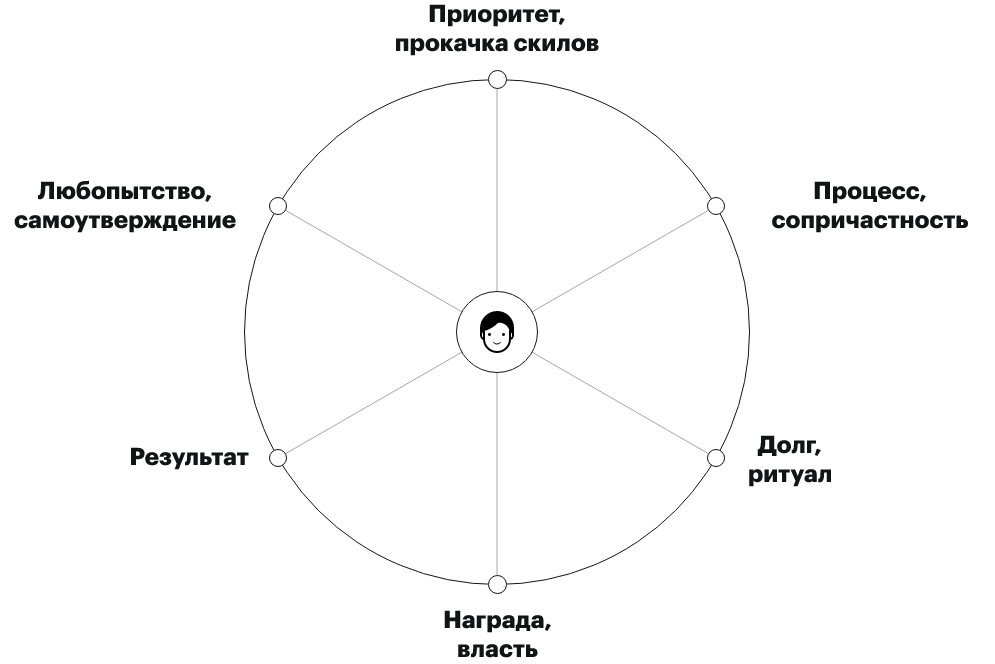
- Priority and skill growth: we did this before anyone else / we can do what almost nobody can do.
- Process and belonging: we’re members of a cool team that values us.
- Duty: we’re doing what, in the big picture, matters to the world.
- Result: we solved a hard problem and can say we did well, because there’s the artifact.
- Reward: I have the prospect of starting to earn more.
- Curiosity and self-assertion: we learned something new before anyone else.
The target profile of a designer
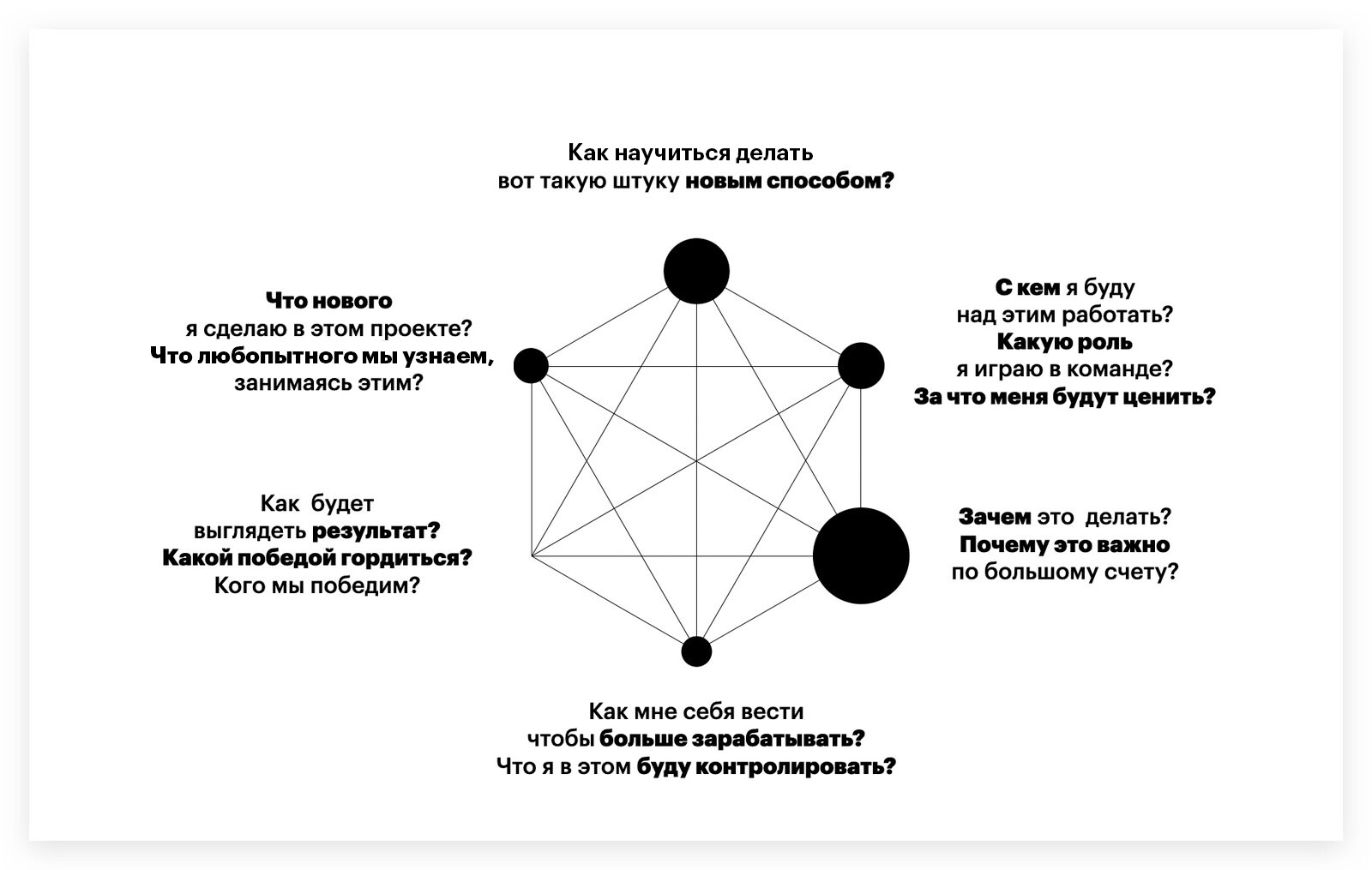
If we talk about a designer, their target profile is roughly this — they’re motivated by:
- Skill growth — often this is the leading motivation. A designer, like any engineer, is interested in the work as long as they’re learning something new. As long as they see that they can make new things in new ways;
- Curiosity — they’re interested in what new things they can make in a project, what curious things they can find out;
- Belonging to a team, at least our designers are like that. This is our strong side — very cool people working on very different tasks. Just put a person into a great team and they’ll feel good in it, and there’ll be no problems with motivation;
- The chance to earn more.
It all comes down to a fairly simple formula of motivation: you have to give the designer tasks in their zone of proximal development, give them sufficiently qualified feedback, bring them into projects they can be proud of, and show that the team values them. That’s it, basically.
Junior designers, the ones no more than three years into the profession, have far fewer problems with motivation. They grow fast, get a ton of feedback, have plenty of tasks they haven’t tried yet, their qualification is rising, and they’re becoming more in demand among the managers who sell their work to clients — which means their salary can go up — it’s all mind-blowing.
What problems come up and how do you solve them?
Problems start at the middle+ level and appear at the point where visions clash over who a designer is — an artist or an engineer.
Long feedback loops
Design stands at the very beginning of the value creation chain, so a pile of problems comes up around closing the feedback loop. The designer has to wait a very long time for what they made to pass through frontend – backend – quality control. And to see how it changes along the way. On top of everything else, over the months while the task was travelling from the designer to production, a lot has happened, and it needs redesigning. And by that time the designer has most likely gone deep into another project, and diving back into the old one distracts and demotivates them.
The solution
Partly to solve this problem, we moved to a product approach in development and design. We really do want the client to get value from our work faster. Not only because that’s more useful for the client and they’ll expand their cooperation with us. It matters to us because it’s far more interesting to work that way. And yes, this is the hardest part, because it requires both teams — ours and the client’s — to be able and willing to speed up TTM (Time To Market).
We sell the wrong thing to the wrong people
When the client doesn’t want to work out together how to change people’s behaviour — you’re selling hands, not heads. The work becomes uninteresting, the value we create isn’t visible, no new interesting skills are needed. In short, no tasks appear in the zone of proximal development for a middle+, and there’s no chance to sell their work for more either.
The solution on the company’s side
In our company we have a formula for choosing a client: we work with those we respect for what they do, and with those who are interested in buying one of our leading competencies: UX, development, and marketing. And as long as that’s the case, there are no problems with motivation.
The solution on the designer’s side
Actually, you don’t have to wait for favours from nature. In every project you can behave as if the client is a good guy who really wants to help their customers. At minimum you’ll respect yourself. At maximum it’ll turn out that the client wasn’t against it, and your vision gets a chance. Yes, for that you’ll have to learn to sell your vision. By the way, if you pull it off, it’ll turn out that you’re not a designer but an art director — not bad, right?
There are no interesting tasks
If you don’t sell what a designer finds interesting to do, they have no tasks with which to grow their skill. On the contrary, there’s a mountain of identical tasks that stopped being in the zone of proximal development long ago.
These are the company’s difficulties, not the designer’s. As long as you can teach the person, as long as they understand that you are the source of their future competence, as long as you can be a sensei for them, there are no problems with motivation. Problems appear when your designer outgrows you, when they become a source of competencies themselves and hit the ceiling of your business. Then you have to change that business together with them. Or they’ll leave you.
The solution
For example, we have an art director who is really into generative design. And there are no orders for it. Which means we have to make people buy what interests us. How do we do that?
- We accumulate vision. The company has to invest in creating and demonstrating certain concepts, because otherwise new products won’t get bought. Designers have to have the chance to do everything they’re capable of, with nobody limiting them. That’s how we grew a fairly strong VR direction, for instance: in 2019 we were the first in the country to launch a WebVR site about the White Tower, and later released our first title on Steam — we’re happy about it.
- We do active sales. More than 20 years on the market, and right now we’re in the top 10 — the client comes to us on their own. But selling something new through inbound is a slow process. Requests for what nobody has done yet don’t just appear. So for that we look for clients ourselves, show them concepts and consult them.
- We let leading designers and art directors create concepts during presale, constrained only by user behaviour and by their own level of skill.
A simple conclusion about designer motivation
To sum up briefly: to motivate a designer, you need to have a vision of the products the market will buy tomorrow, to invest in creating that vision together with your best designers, and to be able to sell it. And the designer needs to learn to create and sell a product vision.