Nine Principles for Working with Silicon Colleagues
I wrote an instruction manual for myself: how to get value out of AI without losing yourself and the meaning of what you do. It's a list of the principles I follow when working with AI on a team. More and more we have to work in hybrid teams made up of people and robots, and that called for some rules of interaction hygiene.
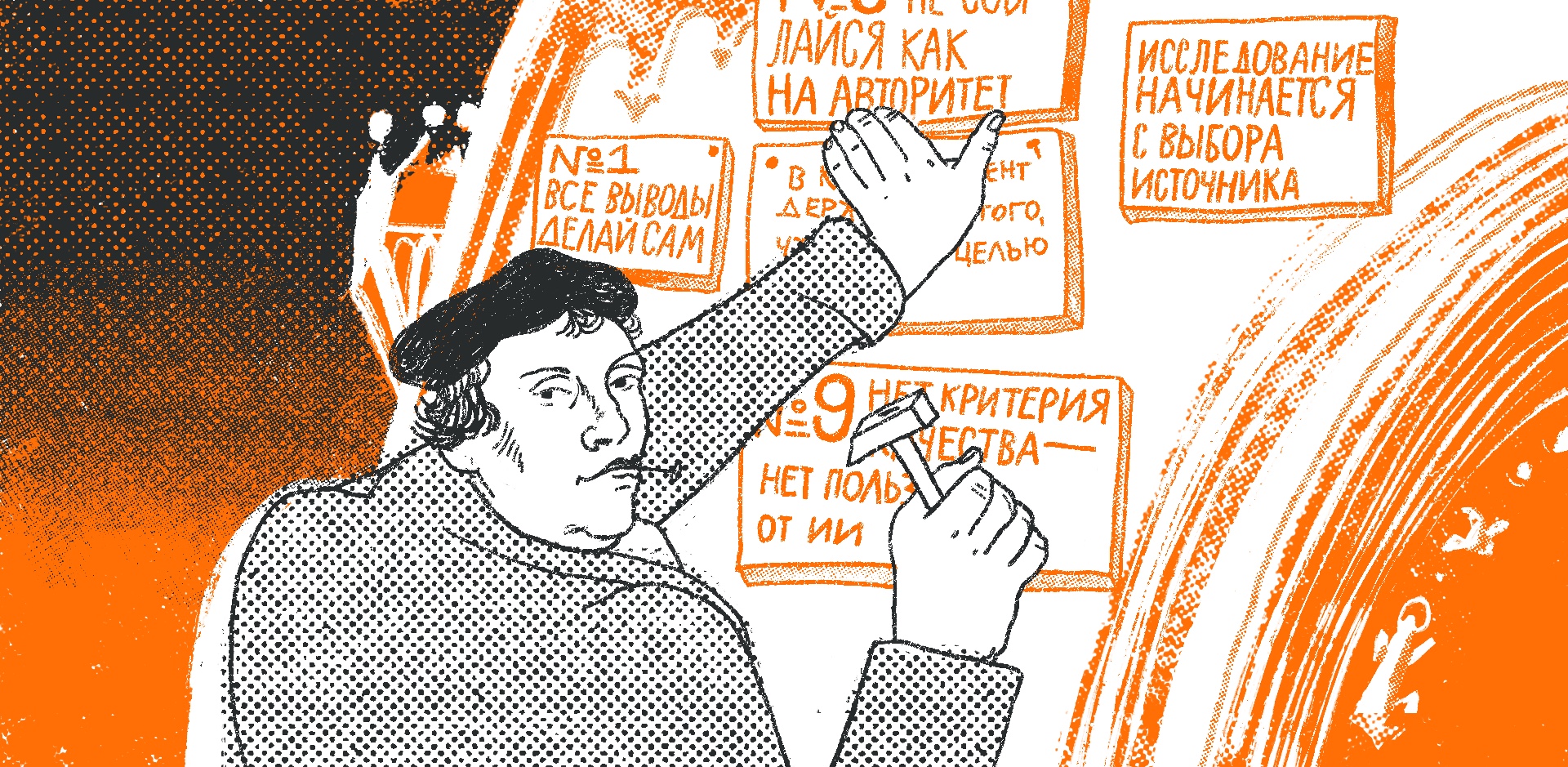
The short list of principles:
- Draw every conclusion yourself.
- Send people only what you wrote yourself.
- Explicitly mark the spots in an AI draft where you have doubts.
- Don’t pass off AI’s work as your own.
- Don’t cite AI as an authority.
- Put context in git and make it usable.
- At every moment, keep what you’re doing connected to the goal.
- Research starts with choosing your sources.
- No quality criterion — no value from AI.
1. Draw every conclusion yourself — be ready to retrace the path to the conclusion out loud
The most important rule: you draw any conclusion on your own, with your own head. No conclusion should ever be drawn for a person by a machine. The test: be ready to tell out loud how you arrived at the conclusions you’re presenting to colleagues. You have to walk the path to the conclusions yourself — and own those conclusions. Same thing as “don’t turn the HADI cycle into a hahaha cycle” © Kharitonov.
2. Send people only what you wrote yourself
The machine can help you do a great deal. But everything you show to other people — write it yourself. Or at least edit it. That doesn’t mean you can’t give the team access to documents the machine made. But what you want people to read — write it yourself. Of course, it’s good to give links: here are the materials I drew my conclusions from, they’re available to you, read them if you like.
3. Explicitly mark the spots in AI drafts where you have doubts
If you do end up referring to a document written by an LLM, treat it as a draft. First read it yourself and explicitly mark every spot where you have doubts, highlight what seems important. Do this work before handing it to others. Otherwise it’s unclear whether you thought about the text at all and whether it’s worth trusting. The simplest way is right in the text, as a comment: Revenue will grow 40% in a quarter. // not sure: figure came from an AI answer, I didn’t check the primary source. That way the reader immediately sees where you’re vouching for something and where you’re not.
4. Don’t pass off AI’s work as your own
Mark it: what you did yourself, and what the artificial intelligence did. Admitting that AI did something is fine, there’s nothing to be ashamed of. But lying about it kills trust.
5. Don’t cite AI as an authority
Under no circumstances can you say “the artificial intelligence said this” as an argument in favour of some position. We make use of the machine’s borrowed erudition, but citing an LLM’s conclusions as an argument is not allowed — it’s professionally incompetent. “The AI said so” is the best way to plant doubt about your competence and devalue all your work.
6. Put context in git and make it usable
Put the project’s working context into the team’s git — sources, intermediate materials, AI products, decisions. For the context to actually be usable, you need to set up a minimum: search, a convenient interface to the knowledge base, a bot that helps you interact with the team’s knowledge base.
7. At every moment, keep what you’re doing connected to the goal
At any moment in time, maintain the connection between what you’re doing with AI and the goal. Keeping activity connected to a goal is the main thing to take care of in general, with no AI involved at all. But in interaction with a machine it’s especially important, because AI often tempts you into expanding the boundaries of the task — keeping focus becomes even harder. The human sets the frame: why we’re doing this, what exactly needs to be done, by what criterion I’ll check quality, and which constraints must not be crossed (which resources to use, what to work with).
8. Research starts with choosing your sources
Right after you’ve formulated the hypothesis and set the goal, the task and the criteria, take care to limit the list of sources you’ll work with. A research request without source selection will give you an arbitrary result.
9. No quality criterion — no value from AI
If you can’t measure the quality of the result yourself — if there’s no way to tell whether what you handed to AI works towards the goal or not — then you get arbitrary quality. And if you get arbitrary quality several times in a row, you’re guaranteed to get bad quality.
P.S.
In creating this text I used Claude to edit several transcripts and turn them into a draft. But every thought here is mine, and the final text was written by hand. The same text on git: https://github.com/kulakov/statement