Moving an Offline Business Online: The Modeling Method
On how to reinvent an offline business for online, and what questions to ask yourself in order to successfully reassemble your business or product.
Why has the need come up to talk about how to move a business from offline to online? On the one hand, the whole current situation is pushing business online; in times of crisis people start looking for non-standard solutions and new approaches. On the other hand, this question usually gets asked in terms of tools: “Which service should I pick so that…”. But in this transition it isn’t enough to just find a suitable tool for running chats and live streams, or, say, drawing on a shared whiteboard. You have to understand the structure of the activity and reproduce its effects in the new environment.
The rakes people used to step on in calm times hit especially hard during this transition. So there’s a reason to talk once again about which questions are worth asking yourself about the business and/or product you’re creating, and which approach will help you reassemble your business or product online.
The business modeling method
I’ve long been convinced that every entrepreneur needs to take a course in modeling. In my case, modeling is part of a tradition I carried over from my experience of making games (applied games, live-action art games, board games, computer games).
From the point of view of a roleplaying game master, a model of a company (or of any other social structure) has one important property — it is a living dynamic system that increases the amount of energy inside itself. That’s not a definition, it’s a requirement: we have to make it so that “the thing comes alive” and then survives, to put it simply. In games this matters because once you’ve made a game and the players are playing it, the world has to respond to their actions, they have to get feedback. And in a game we can’t afford to have written-out scripts and instructions for everyone. Players have their own motives for acting, they play freely — and we can’t steer that through a manager’s direct will or through rigid instructions for every occasion. We need to make the system start living — which is why we have to imagine how it behaves in motion, invent means of indirect control, and lay motivation, problems and forms of interaction out across the playing field. To understand and manage this, you have to learn to see the structure of what’s happening, learn to design and control the model of the game.
And what about in business? On the one hand, a company usually strives to control every significant action of every employee. But on the other hand, you actually very much want employees to create their own activity within certain rules, for people to be subjects who act by their own will and for their own goals — and for those goals to be shared with the company. Hence the opposition: on the one hand you need control (to scale and to cut costs), on the other hand you need agency (to develop, to raise leaders, and generally to create something new and adapt).
When I design relationships inside a company, I do exactly the same thing as when making a game — I come up with rules under which people’s free “play” will produce results that are valuable for the system. And that activity will be voluntary, interesting, and ultimately will increase the system’s energy. That is, the rules of the game will make it so that everyone’s free play leads to greater survivability for the company. I use modeling for this.
I spent a long time thinking about how to explain to people how to use this skill in a way that makes it hard to fake the activity when you try to implement it (to pretend that we’re doing some practice while not actually doing it). The simplest option I’ve found is to build the model by describing what exactly people do. That is, we don’t talk about which metrics, tools and KPIs there are, we talk about people’s experience and about scenarios.
Put very simply: which people do what, and what for. What quality does these people’s activity have? What do they feel? What experiences do they have? For marketing this matters especially, because people, in fact, never buy anything in their lives except the hope of an experience or the guarantee of an experience. Life is the only adventure that happens to us, and everything we can technically discover in it is our experience. All our conscious actions are aimed at changing it somehow. So when I describe a model of activity as it applies to sales, I focus on which experience we promise and on how people perceive it before, during and after.
When we buy something, we hope that our life will change. We don’t buy anything except that hope.
Let’s try describing the systems of various offline businesses as systems of experiencing actions.
Modeling online food service
Why do I go to a café? Not just to eat, after all. Let’s look at the whole scenario.
For example, my friends are back in town, we haven’t seen each other in ages, and I think: “I should meet up with my friends.” Then we choose where to go. We don’t say it out loud, but we’re weighing up which place will make us feel like friends. Why? We want to feel exactly that: we haven’t seen each other in a long time, it’s warm and comfortable together, we can tell each other stupid stories… By the way, the food will be good and it won’t be noisy — or, on the contrary, it will be noisy, if we’re picking the place for a different mood. But when an establishment takes on the task of moving online, as it does now, it ends up just doing delivery. And that won’t give us, the customers, the emotions we would have gone there for.
What can you do to give people the emotions they used to go to a café for? For example, deliver the same set of food to different addresses, so that it’s as if we were sitting together eating the same food. Will that work? Probably not. It seems we won’t feel each other’s warmth from that. We need some kind of joint activity, or at least a reason to talk. So that we feel: “We’re together, we have our own space, and in it we feel comfortable.” And after that come the shades of it. We need a reason and a format for talking.
The barrier is that with food delivery, nothing creates an atmosphere for conversation. Could that be part of the service? The moment we’ve found the barrier that stops the target experience from arising, it’s already clear what needs to be done, which inventive problem to solve, what to come up with hypotheses about.
For example, you could make sets of food plus a movie to go with it, the way wine gets paired with a snack. If it’s a romantic evening, then one food set and a romantic comedy; if you want to have fun, different food and a different movie. Plus a set of warm-up questions (assuming people don’t always know how to start the evening). Or a party-game script for that. Will it land? Will it increase sales? We don’t know yet and won’t know until we try, but it might give people the emotions they used to go to a café for.
Then this service will have a different buyer than plain delivery does, and you can charge different money for it. It’s a reason to partner up with other services, to pick different distribution channels, and there’ll also be something for the media to write about, because it isn’t yet another food delivery.
Just in case — I’m not trying to say that people go to cafés only for this, or that “just delivery” doesn’t matter. I think you know better than I do why people come to you, if you own a café. All I’m saying is that once you understand which emotions people got from the offline experience, you can give them a similar experience online — by changing the structure of the activity.
There is a risk, though: after such an operation you can discover that you’re now running a completely different business. To give people, in the new environment, the thing they used to give us money for, you’ll have to do a different kind of work. And it may turn out that we’re not as good at that new work, and that it’s a job for entirely different people and companies.
That’s why the goal is to find changes that lie in the business’s zone of proximal development.
We were good at something, but that something stopped working — and to keep living in the new environment we need to work out which skill our business should grow in order to stay in demand.
One step may be enough to give us the differentiation we need, and after that we can go quite far down that path.
Of course, not every business can be reinvented this way. There are cases you can’t reinvent — oil extraction, for instance, can’t be dragged online no matter what. In that sense the method has a limit. But food service is far from the only field that lends itself to reinvention through a model of actions and states.
Modeling online education
If we apply this method to education, we’ll discover terrible things. For example, that the states people experienced offline are not at all the states we want to reproduce.
Take the classroom-and-lesson system. Let’s answer honestly: what emotions do schoolkids feel when they’re sitting in class? “Ugh, the teacher isn’t saying anything, and I’ve got a great game here on my phone.” And there’s a whole bouquet of emotions about doing something interesting instead of the lesson without getting busted. And also “please don’t let them call me up to the blackboard,” and so on. In that sense, most of the emotions that offline education actually creates are nowhere near the emotions we want to carry into the new environment.
The point of a business, and of any activity at all, is for people to change in the way they want to change, because they won’t pay for anything else.
With education this convention isn’t so obvious, because it isn’t entirely voluntary. If the person paying isn’t the person taking part, then it’s not the student’s life we have to change but the client’s. And if it isn’t voluntary, everything starts to slide and split at the seams. On top of that, state universities and schools are tied financially not to what parents or children think of them, but to what the ministry thinks. In that sense the method I’m talking about is market-only — it’s for when you want to change the behavior of a client, that is, of whoever pays you money.
But let’s get back to which emotions from education we really do want to reproduce. For example, these:
-
“I’m getting it! I’ve learned a cool thing”;
-
“What I can do now should make my parents and friends respect me”;
-
“I’ve discovered there’s an interesting field, and now I want to develop in it”.
Let’s ask ourselves: how do we recreate that experience? Take something more alive than classroom education, something where there’s a chance of the target experience. Hackathons, for instance.
A badly made hackathon looks like this: “Hey folks, here are some so-so prizes, there’s pizza (a good factor, by the way), you’ve got one day, at the end of the day you’ll come up on stage, we’ll pick some of you and give somebody an award. Oh, and the jury doing the picking will be incompetent.” And that’s it, we’ve sort of made a hackathon.
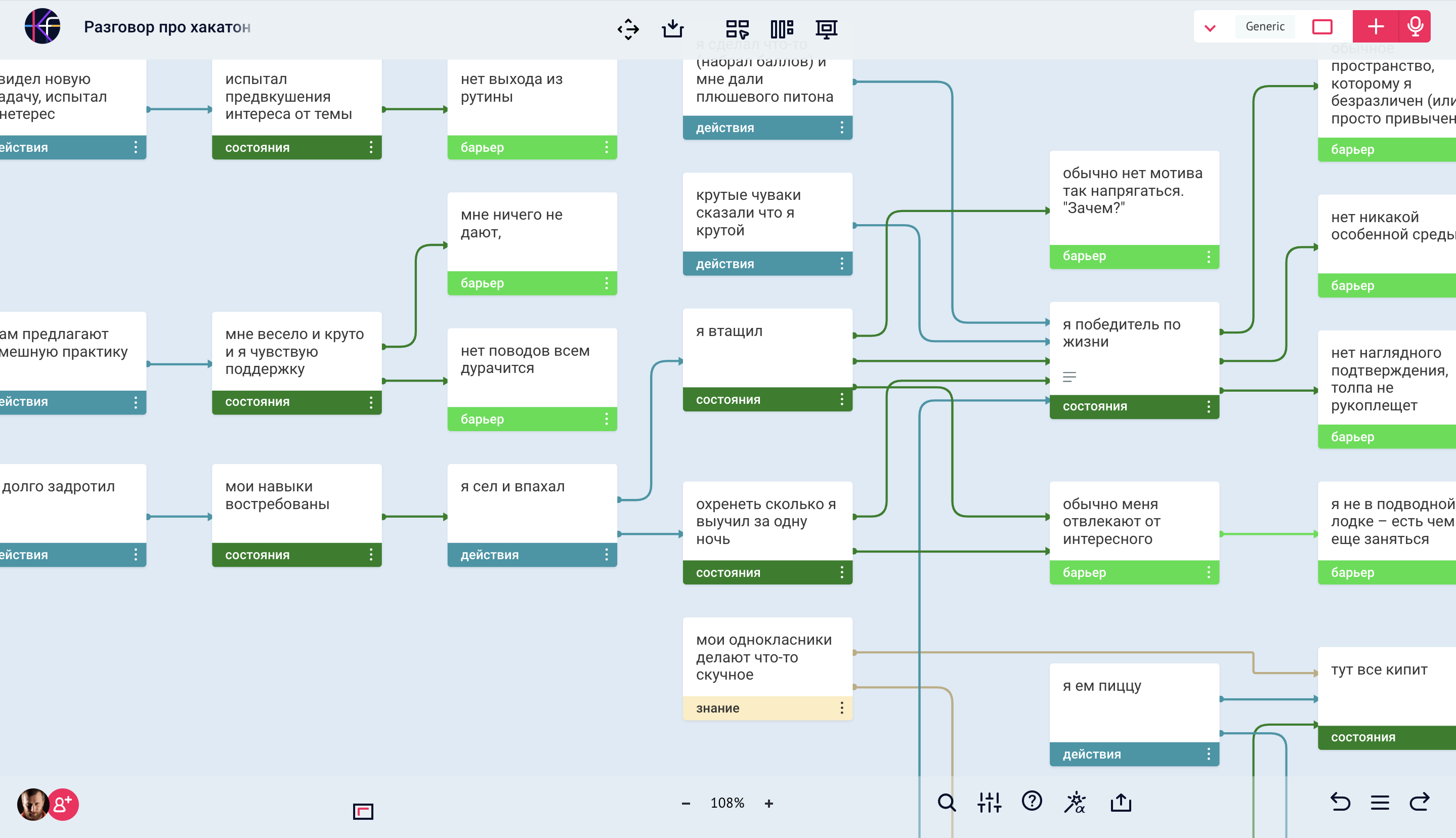
A fragment of a diagram of the experience people get at a hackathon. The actions that used to produce those states run into barriers in the new environment. Diagram made in knowflow.io.
But there are good hackathons too, where the organizers put in the effort to make a person feel the following:
-
“I came alone, but now I have a great team, and there are people in it just like me”;
-
“Well, what do you know — people see a living human being in me and respect me for who I am”.
Actually this isn’t hard to reproduce online, there’s just a lot of work involved.
Say I want a person to realize that cool grown-ups notice them — then I have to make those grown-ups actually notice them. For example, have one of them call and say: “Hi, I read your application, you’ve got some great independent thinking in there. Listen, I know three other people like you, and I want to give you all a trial mission.” That way the participant will understand that they’ve been noticed, that they matter, and will have the target experience.
But to do that, we’ll have to do a fair amount of work:
-
Learn how to praise,
-
Make sure participants have a reason to write down independent thoughts,
-
Read them,
-
And find our own thoughts about their thoughts.
In other words, we’ll have to treat them like adults — which is exactly what they want.
We need to create an experience through which people learn something new, and are themselves recognized for what they’ve achieved. For that we need an activity that will be perceived as valuable. It will turn out that the results of that activity are actually needed by someone, that it isn’t only educational work, that someone will use it in real practice. Which means you have to embed educational tasks inside practical ones, you have to find a source of that practice — that is, find partners who won’t just give you money but will say: “We have this research problem, and we’re ready to spend our time and attention on you.”
As a result, participants will have both a motive for the activity and a form for it. And then we can break it down in more detail:
-
To write a program in Python, you first have to learn Python;
-
Here you’ll need to apply methods from mathematical statistics, so you need to understand mathematical statistics,
-
And so on.
In that sense, hackathon participants need to be given tips & tricks: “Look at how to hack this problem.”
What I’m describing here I took from a conversation about exactly this kind of hackathon. I was helping the NTI Circle Movement — people who are very good at running hackathons offline and who reinvented theirs for online.
On April 18–19 the NTI Circle Movement ran its online hackathon as part of Local Hack Day 2020. Participants were given the task of developing, within two days, projects that would help solve problems caused by the current pandemic.
The results: 582 registered, 234 passed at least one checkpoint, and 155 participants presented their project. Among the winners: a game that introduces players to the rules of behavior under quarantine; a nucleotide analysis project which found a relationship between SARS-CoV-2 and the SARS and MERS viruses; a model for fact-checking claims about the coronavirus with 65.8% accuracy.
Circle Movement — the online hackathon (video)
Here Maria Rachinskaya, vice-president of the Association of Circles and head of the Circle Movement’s “Practices of the Future” project, talked about how the preparation for the event went: about the move online, about participants’ motivation, about the typical barriers in switching to an online format, and about creating the necessary atmosphere. If you’re interested, you can jump straight to how the modeling method was applied.
Modeling online events
There’s a view that some formats can’t be moved online. The reception at a conference, for example. But let’s think: what do we feel when we meet someone at a reception whom we haven’t seen for a long time? “We’re together,” “he’s glad to see me,” “he finds me interesting,” “somebody cares about my life,” and, by the way, “I care about his life.”
Small talk at a reception is a way to feel an emotion, not an opportunity to exchange information or eat a canapé. So if we’re thinking about how to move that kind of format online, we need to make it so that a participant feels the other participant has a genuine interest in them right now, that you support each other. Online lets you go through that perfectly well.
When we talk to somebody online we don’t hug, of course, but we feel the other person’s attention and get quick feedback from them.
And if we’re doing an online event, we need to make sure people have:
-
A chance to talk face to face (or in small groups of 3–4 people, otherwise there’s no intimate space),
-
Time for it,
-
A reason for it,
-
A form of activity for it.
And we’re the ones who have to invent that for them.
Here’s what I like to do, for instance. We split people into chat rooms in advance on some principle (depending on the goal: either we’ve seated you with strangers so that networking happens, or with a group of old friends so that you all get the “oh, long time no see” feeling together). There’s a speaker, they say something, but not for too long, and everyone listens sitting in their chat rooms. Everyone has an assignment to respond somehow to what was said. You listen to the speaker knowing that once they finish, you’ll have five minutes to talk in your chat room, and after that your chat room will have to say something in the public space about what you heard.
The upshot:
-
We got engaged listening from the participants,
-
The speaker got more attention, and therefore a pile of good questions,
-
People got a reason and the time for contact — they have a deadline to meet, and the result of their conversation was in demand.
And if that speaker then picks the top 3 questions, the result also gets weighed — there’s a motive to make it good.
None of this is clever. I do the same thing offline, but all of it is achievable online too. And note: only at this step is it time to think about the technical setup for the event — because only now has it become clear what we need.
Modeling online tourism
This one is a “starred problem,” of course. Sadly, tourism is genuinely hurting right now. If we start the analysis, we’ll find that similar impressions can be delivered, but the business will be an entirely different one — it will be built on something else. And identical impressions can’t be delivered at all, because the only thing better than mountains is mountains. But let’s try to do something.
Take a classic package tour — we go somewhere as a family to unload our heads, to feel that we don’t have to take care of anything, that there’s stuff to do, that there’s some interesting program, that the kids are occupied too. There’s the sea — I dove in. The sea, of course, will be the hardest thing to reproduce right now: it’s physically a different environment, and tourism in general has a lot of “body stuff” in it, and that has been reproduced at a distance with difficulty at best. Still, it becomes clear that you actually can build a “vacation at home” service. And why there still aren’t any, I don’t know.
Why can’t I pay some people money to take care of me for a month? I don’t have to cook at home, they come up with a program for me… Actually that sounds like shut up and take my money, if you ask me.
For example, you get a person who handles your leisure. They’ve put together a program for your entire vacation, they call you and say: “Today we’re doing this; by the way, everything you need is already on its way to you, watch out for the courier.” Honestly, that’s fine by me! Something like: “Today I’ve prepared a movie for you, tomorrow we’ll be sculpting with clay, and the day after, everything for cooking arrives and we’ll make chicken tapaka.” This isn’t tourism, of course. Such a business is built on similar emotions, but it’s a surrogate. The only thing better than the sea is the sea, there’s no way around that. But if we’re sitting at home for whatever reason, then a business about vacationing at home — why not. There’s something there worth paying money for.
Instead of a conclusion
I value the modeling skill a lot, because a business is a living model that changes somehow. To manage it you have to understand how it’s built, that is, understand the model of the business and the model of the market. I know two ways to teach modeling: screw up a few businesses, or make a few games. No third method that works as well has ever occurred to me, but the model of actions and states does help somewhat.
When I describe the practice of modeling, it seems elementary to me, because all you have to do is understand what people do, what emotions they end up feeling, and invent an activity that will make them feel those same emotions. Probably it seems that way to me because I’ve made a lot of games. Try doing it this way. If it doesn’t work out — come to me, I’ll advise you on something.
That’s an offer, by the way. If you have an interesting problem, or a strong business competence that lacks an understanding of how to reproduce the experience online — write to me, let’s talk.