Start with the Cherry! Identifying the Main Process in a New Product or Business: the Search Principle, Methods, Examples. Part 2
We're carrying on the conversation about launching a new business or product. You have a vision and your interpretation of it. But how do you find the main process, the one that sets your idea apart from the others?
So, let’s briefly recall what we talked about last time.
- A business vision is an idea, a notion of how the product will be built when it comes to be, how the world around it will change, and thanks to which properties of the product that will happen.
- Sometimes the main thing required of an entrepreneur is to give birth to a vision, a picture of the desired future. Without a vision there’s too little energy in a business.
- The business idea is most likely wrong in its specific details. It has to be tested before you spend money on automation.
- If you want to change people’s behavior in order to solve their problems, and that’s what drives you, then defend that and build the work around it. The vision is a symptom of that problem. It’s valuable, but not as a set of features.
- If you formulate the idea as a set of features, that pushes you toward implementing those functions rather than toward testing processes. As a result you get program code, not changes in the business.
- One of the processes will be the trunk, the load-bearing structure, and the rest will be branches. Start from the trunk.
- If we automate something, we’re assuming it’s supposed to be exactly like this and won’t change in its main features.
And now let’s move on to how you identify the main process in a new product and which methods you can use for that.
You have to start with the cherry, and build the rest of the business afterwards
It’s impossible to understand right away how an innovative product ought to work, especially if it’s a large system with a lot of connections and doesn’t yet have any coherent architecture (it’s an innovation, after all — nothing like it existed before). So instead of automating everything, the first thing to do is find the process that limits the performance of the system and come up with a means of removing that limitation. Automation can be one such means.
Which raises the question: which process is our main one, and why? Here you have to go back to whatever it was that made you come up with the business idea in the first place.
An example
Here’s a young mother who’s a programmer — she’s still on parental leave, but she’s already starting to work and take calls about work matters. She can’t mute the microphone, because she has to talk. And her colleagues can’t hear a thing, because there’s a child screaming next to her. And then she thinks: “It would be great if there were a neural network that could pick out the surrounding noise well and tell it apart from my voice. Then I wouldn’t have to go hunting for a quiet corner, and I’d hear the child while my colleagues wouldn’t.”
Obviously this isn’t only about a child crying, it’s about a lot of things. It would be a great technology for video messaging. And, leaning on that feature, we’d sell our product to everyone as the most workable option ever: a video messenger where you don’t have to put yourself on mute. There it is, the cherry on the cake. (Yes, I know that Discord is famous for exactly this feature. It’s just an example of how that kind of positioning can come about.)
But now we need to draw the rest of the damn owl before we get to the thing we decided to start a business for. Before we start testing our hypothesis, we think:
- Okay, we need to choose a video-messaging technology
- Build user accounts
- Write the chats
- Make video and audio signals hold up on a bad internet connection
- Learn to balance traffic and compress the video signal
- Come up with an onboarding scenario
- And a million other things
In short, a whole woodpile of work. And off we go doing all of it. And once we’ve done all of it and we have clients — then we’ll make our cherry and live happily ever after. But! If we go that route, the cherry will never get made. We’ll be carried off in a completely different direction from the one we started all this for. And maybe we’ll even survive, but the dream won’t be realized.
You need to find a way to start the business with the cherry.
In this case, if we want to make work chats such that nothing distracts the employees and they’re online all the time, we need to look for a situation where we can start the changes with exactly that. For instance, let’s make a plugin for Zoom. Or build the technology and have video messengers as our clients rather than end users. And not even the whole technology, just the fragment of it responsible for separating the useful signal from the noise. Better still, let’s not build it — let’s fake it. Yes, at the start this doesn’t look like a big business at all. Yes, we’re unlikely to become a “unicorn” on this alone. But this way we test exactly the hypothesis we were setting out to test. It will be in exactly the part of the user experience that gave us energy. In the part of the market that our entrepreneurial intuition was pointing at. In the part of the technology our engineers wanted to work on, because they’re good at it. And then, if it all worked out and if the cherry really is tasty, we’ll make our cake. And that, by the way, sharply increases the chances both of the business succeeding and of it growing fast.
To find the cherry — the thing that will solve the most critical problem — I usually use two frameworks: the one about finding the bottleneck, and the one about the riskiest assumption. Those are what we’ll talk about next.

Looking for the cherry with the help of the market’s bottleneck
Eliyahu Goldratt, the author of the Theory of Constraints, described several analytical methods that help you find the factors limiting a system.
The first method is to work out what there is inside the system that clearly leads to undesirable consequences. You write out all the negative factors and connect them with arrows showing what happens because of what. That’s how you find the thing that generates the most negativity and where the biggest stream of trouble is flowing from — i.e. the root cause, the factor that, once removed, gives you the maximum of positive consequences.
And along the way you use Goldratt’s cheat sheet — the categories of legitimate reservation:
- Clarity — everyone understands the statements used in the construction in the same, unambiguous way.
- Entity existence — the statement contains a complete thought.
- Causality existence — does the named cause really produce the stated effect?
- Cause sufficiency — the named cause is sufficient to produce the stated effect in this context.
- Additional cause — might the named cause be only one of several possible ones?
- Cause-effect reversal — might it turn out that cause and effect have been mixed up?
- Predicted effect existence — if the named cause is present, then it should have not only the stated effect but also some other, side effects (which don’t necessarily have to be taken into consideration — you just need to make sure there are no side effects).
- Tautology — the effect is being offered as the grounds for the existence of the cause.
How else can you spot this place?
The second method is to find where a stock of a resource piles up, because that fragment of the process can’t cope with processing it. For more on this, read Dettmer.
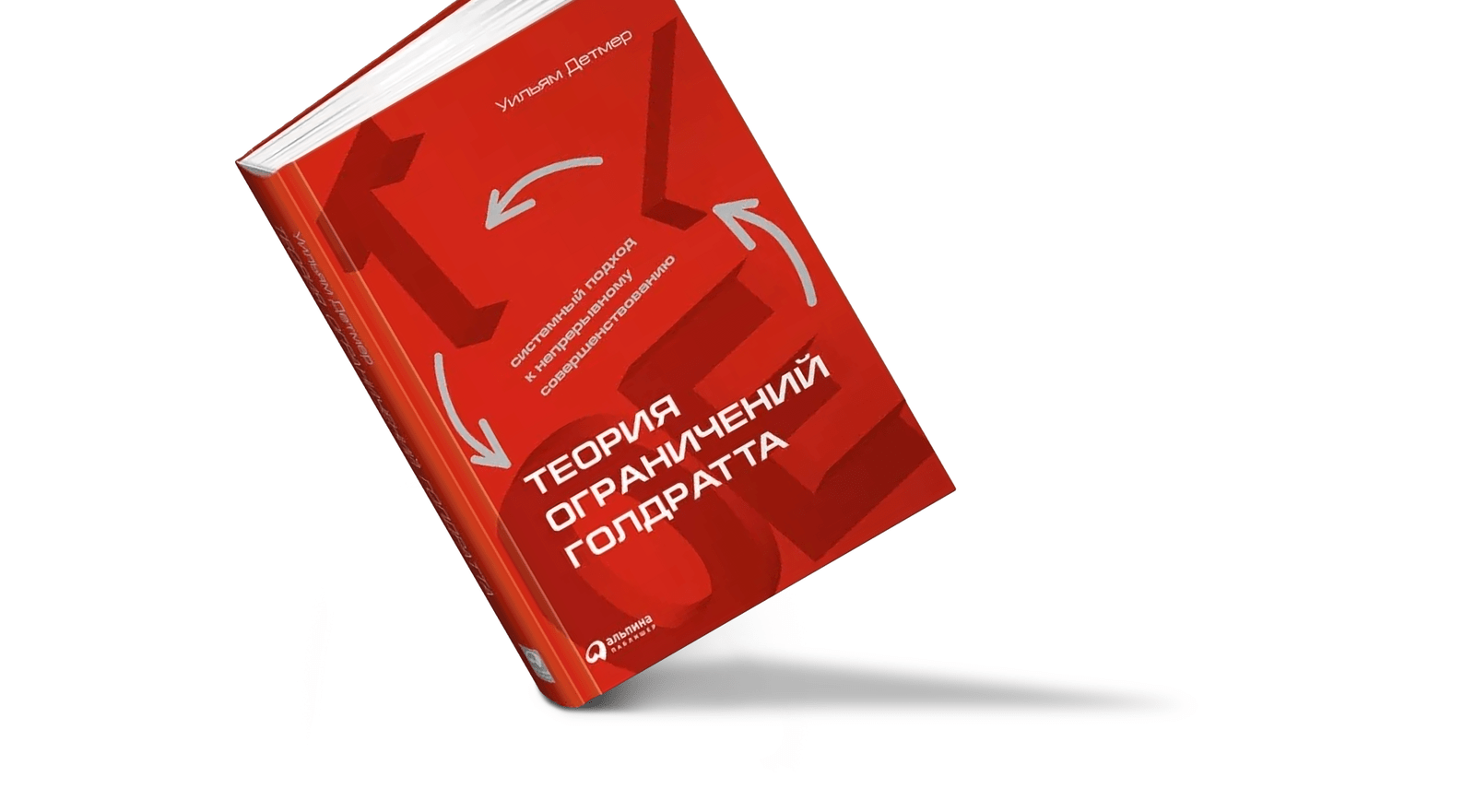
“Goldratt’s Theory of Constraints: A Systems Approach to Continuous Improvement”, William Dettmer
For the product we’re about to create to bring value to the business, we need to find that place. If we’re creating a product for internal use, it will be the bottleneck of our own processes. If we’re creating a product for an external market, it will be the bottleneck of the market. The thing it handles badly. The factor whose change brings control.
When businesses try to calculate the price of the value they bring, they often try to tie it to the cost of an hour of a specialist’s time that’s been saved. But if we automate not some random process but the bottleneck, then the value created is far greater than just the cost of the specialist-hours saved. Because it’s an hour saved for the whole system. And you can bring that kind of value not just to one enterprise but to an industry as a whole. Because enterprises within one industry are arranged in roughly the same way, and their limiting factor is often the same one too.
Why is it important to solve exactly the thing that generates the most negativity, or the thing that creates the biggest jam?
First, because you’ll get paid more for it. And second, because it’s the easiest thing to sell, since that’s the spot where it hurts for everyone. You found a way to turn juniors into team leads in three months? Or you can do delivery within the Moscow Ring Road cheaper than the competition while keeping to a 15-minute window? Shut up and take my money! Maybe the decision-makers aren’t fully aware of the problem. Maybe they’ve never reflected on it. But every one of them has that spot rubbed raw — which is why this kind of thing is easy to sell. And you can ask good money for it. Sometimes it isn’t obvious and is hidden away, and then in your communication you have to make clear what the problem and the limiting factor are, and which words real people in a real process use to talk about it.
Looking for the cherry with the help of the riskiest assumption
So an entrepreneur has a vision. They’ve come up with something, and they have certain hypotheses about what needs to be done. And not just any hypotheses, but hypotheses about processes — about how people will behave: their clients, their employees, someone else.
There are businesses where the most important, riskiest hypothesis is visible right away. The people working in them already know which factor determines who wins the competitive fight. It’s clear what has to be delivered, but not clear how. Plenty of people have tried and nobody has managed to do better than current practice, but everyone is fighting over exactly that factor.
How do you find the riskiest hypothesis in a simple way?
Through risk analysis. List your assumptions about success, and for each of them estimate the answers to two questions:
- If the assumption doesn’t come true, how bad will it be for the business as a whole? (As a percentage: 100% — there’ll be no business at all, 0% — it’ll have no effect on the business whatsoever.)
- How likely is it that this assumption will be refuted? (100% — this is already a working, stable process, 50% — we have reliable data that it works for others, 0% — it definitely won’t work.)
And multiply them together.
So that you don’t forget any of the important assumptions, here’s a list:
- An assumption about the clients (who they are, where they can be found, how many of them there are);
- An assumption about the problem (what the problem consists of, what clients do to solve it);
- An assumption about the solution (how far our product solves the problem, whether clients’ lives really will change as a result of using it);
- The MVP, or the way to test the problem (how much functionality will be enough to deliver the value, what quality has to be created for the client to make use of the result);
- Competitors (who else is solving this problem, where they’re vulnerable, whether the competitive advantage we’re creating is enough for us);
- Sales channels (where we’ll sell our product or service, how much a client will cost us, how many clients we’ll be able to find over a period of time).
In different businesses different factors turn out to be the key ones for success. You have to test the business’s viability starting with the most critical one.
Example 1. IT
Even after all the upheavals of recent years, the industry is still limited by the number of experienced programmers. If we can turn a junior into a team lead cheaply, quickly and predictably, then all the money in the world will be ours. It’s just that first we have to learn how to do it.
Example 2. Supply markets
For many decades now people have been trying to solve the problem of how to make it so that a procurement specialist not only knows who sells the goods they need (there are catalogues for that), but can also see current prices, quantities, or at the very least whether different suppliers have that item in stock. Here the key factor is knowing in real time whether an item is in the warehouse and at what price. That’s what needs automating. But the problem isn’t just that this is hard and expensive to automate — it’s that the market simply refuses to march in formation. And it’s clear that whoever solves this problem will bend the supply market to their shape.
Example 3. Foodtech
One of the most important factors in the food trade is the price, speed and predictability of last-mile delivery. What changed the foodtech market? The fact that in big cities — Moscow, for instance — it became clear that if a courier brings food in under 15 minutes, people change their consumption habits. The ones who used to cook start eating ready-made food. And if you’ve found a reliable delivery service that works fast and predictably, you become a regular customer, and the product’s customer lifetime value grows.
So here the key factor is predictable delivery within a 15-minute window. And whoever delivers higher speed and predictability raises customer lifetime value, gets more loyal consumers and earns more.
The second important factor is the cost price of a single delivery, which has another million processes baked into it (the cost of a courier-hour alone includes their wages, taxes, insurance, the cost of hiring, transport, maintaining that transport, and so on). You can go about lowering the cost price in different ways: for example, make reliable and cheap electric bicycles that never break down. Or train couriers very cheaply and reliably. Or optimize their routes so ferociously that they make more deliveries per run. Or you can put refrigerators everywhere, split one delivery across a number of portions and radically cut the cost of delivery. The solutions can be very different. But control over the market is largely determined by who can afford the lowest prices, and in this case the price of delivery is a substantial part of the bill.
In general — if you talk to the market leaders about why their market share is the size it is and not much bigger, they’ll tell you what their growth is running up against, which factor. That’s the riskiest hypothesis, and the answer to the question “Why, most likely, won’t this work out for us?”. If that factor is delivered, the business will happen. And if it isn’t, the other factors don’t matter.
If you don’t have access to that kind of expertise, you’ll have to find the answer to the question “Which wrong assumption would do my business the most damage?” on your own. To do that, write out all the assumptions about why your business will be successful, and for each assumption determine:
- How strongly this factor affects the success of the business (1 — almost no effect, 5 — if this factor doesn’t work, we lose half our business, 10 — if this factor doesn’t work, there’ll be no business at all);
- How likely it is that this factor won’t work (1 — this factor is already working, we can observe and measure it, 5 — there’s reliable practice of implementing it, but not at our place, 10 — this is a completely new method that neither we nor any company we know of has used).
Multiply and rank by the result.
Of course this is a very crude measurement — all it tells you is what you think about the risks of your assumptions. That is, we take what we know, rank it and start testing the hypotheses from the riskier ones to the less risky. In other words — first we secure the critically important factors for our business, and then all the rest.
If we look at the foodtech example from this angle, what could go wrong? Electric bikes could be banned, and our advantage turns into a pumpkin. Or our courier onboarding technology leads to a high percentage of theft and dissatisfied clients (because we recruit very cheaply and in large numbers, but take just about anyone).

You’ve found the cherry — now make sure it’s tasty
If you’re confident that you’ve found the market’s weak link and understood what is the most important thing in your idea, the thing without which everything else goes down the drain — then that’s exactly what you should be working on.
For the “cake” you don’t need experiments, because the market has already learned how to make cakes. Meaning: in every market there’s a best practice for building the business. You don’t need to test it experimentally, that’s expensive. If there’s a reliable solution — just use it, don’t test what’s already known. One day you’ll have to make the whole main cake, but money should be invested in you not for being able to do what everybody can do, but for being able to solve the critical problem better than anyone. Because it’s that factor that’s capable of changing the state of affairs.
So start baking the cake with the cherry. It’s the cherry, after all, that has to be invented and tested. It’s the cherry’s properties that everything hinges on first and foremost. It’s the way to solve the problem that the whole market is trying and failing to beat. All that’s left is to make sure the process works as it should: delivers value to users and brings money to its creators.
Conclusions
So, if you have a vision of the product and of how the world around it will change thanks to it, then:
- Put the list of the product’s functional properties away somewhere far off
- Concentrate on analyzing which process limits the effectiveness of the business as a system
If you know the market you’ve invented the product for well, your intuition about your subject area may be enough. If that expertise isn’t enough, find someone who’ll share theirs with you. And you also need to know how to launch products. If you’re short on product competence — come and see us. That’s exactly the thing we understand.
If the product in your vision is a large system with a lot of connections, don’t try to automate everything at once. First find the main process and automate that. There are two ways to find that cherry: with the bottleneck, and with the riskiest hypothesis. These methods complement each other, and they can be combined.
I, of course, prefer to start with Goldratt’s methods, because I love Goldratt. But it’s hard. And it’s not a very popular way of thinking, because what it says is: “Dear friends, it’s too early for you to give birth to a vision, let’s do some analysis.” And everyone goes: “Oh, get lost with your analysis, we’ve got an idea here. Analysis is dreary, the idea is cool. What’s all this now?” The students on my product-creation course at UrFU behave in roughly the same way, and you can understand them.
If you don’t have a command of these methods, it won’t be easy without a donor of that competence. You have to be able to think in a specific way. So if you happen to need help with that — write to JetStyle on Telegram: @jetstyle_bot. We’ll discuss your idea and find where the cherry is in it together. And if you’re short on competence in building products, in development or in marketing, we’ll become one product team with you, to test the cherry and realize your idea.
And now, in theses
All the important thoughts in one list:
- Automation is a way to create an innovative product. But instead of automating everything, the first thing to do is find the process that limits the performance of the system and automate that — and that will be your cherry on the cake.
- Starting with the cherry means testing exactly the hypothesis you were setting out to start the business for. And the cake has to be made afterwards — if it all worked out and if the cherry really is tasty. This sharply increases the chances both of the business succeeding and of it growing fast.
- The first way to find the cherry is with the bottleneck. We work out what there is inside the system that clearly leads to undesirable consequences. Or we find the place where a stock of a resource piles up, because that fragment of the process can’t cope with processing it.
- The second way to find the cherry is with the riskiest hypothesis. It’s the answer to the question “Why, most likely, won’t this work out for us?”. To formulate it, you need to know the factor that determines who wins the competitive fight. If that factor is delivered, the business will happen. And if it isn’t, the other factors don’t matter.
- To understand whether the cherry turned out tasty, you have to make sure the process works as it should: delivers value to users and brings money to its creators.
- One day you’ll have to make the whole main cake, but money should be invested in you not for being able to do what everybody can do, but for being able to solve the critical problem better than anyone. Because it’s that factor that’s capable of changing the state of affairs.