How to Manage a Product Portfolio
A product portfolio is a way of splitting one big company goal into fragments and managing risk. How portfolio goals differ from the goals of a single product, how the BCG matrix helps you decide what to do with each one, and why the hardest decision is stopping investment.
A product portfolio forms around the company’s goal
Companies group products around a goal. For example: to become the leader in a particular market, to hit a target revenue figure, or to raise the value of the business. Broadly speaking, the products in a portfolio are ways of solving separate fragments of one big task. In other words, a way of managing risk. That’s because the success of each individual product isn’t guaranteed. So when a company develops its product strategy, it needs some number of candidate products it bets on to close off fragments of the goal.
A strategy is created to fit a goal. There are many management strategies, and it’s hard to fit them into any single scheme. Some strategies imply a clear roadmap you have to stick to. Others are more flexible. But in any case, the criteria for evaluating the products in a portfolio are the goal broken down into separate factors.
The goals a product portfolio faces are the company’s goals, not the product’s. By company goals we mean some picture of what the business wants. For example, to become number one in a particular market segment, to squeeze out the competition, or to have a bottle of Coca-Cola in the hand of every person on the planet.
This matters, because when we talk about the goals of a single product, one way or another it comes down to standalone success. But when we talk about a product portfolio, that goal is set for the whole portfolio, not for each separate product. So a portfolio can hold products with loss-making economics that nonetheless build a customer base for other products in the portfolio. Or they can be internal products that lower the cost of transactions inside the system.
So a portfolio is a way of reaching the company’s goal through the selection of products and the goals set for each one as a separate fragment of it. The main instruments of portfolio management are investment and the criteria for checking product performance. They’re what decisions are made on about what to do with those investments in future: continue, stop, sell, or write off.
The hardest and most painful decision is stopping investment.
The hardest and most painful decision is stopping investment. That comes from the sunk cost trap, and also from the fact that over the course of the work personal relationships form between investors and teams.
The main question in managing product strategy is which product to give the scarcest resource to. It isn’t always money — it can be access to a flow of key clients, or the best people.
To manage a portfolio, you need to be able to evaluate the products in it
Different instruments are used to manage a product portfolio. One of the most popular and the easiest to understand is the Boston Consulting Group matrix, or BCG Matrix.
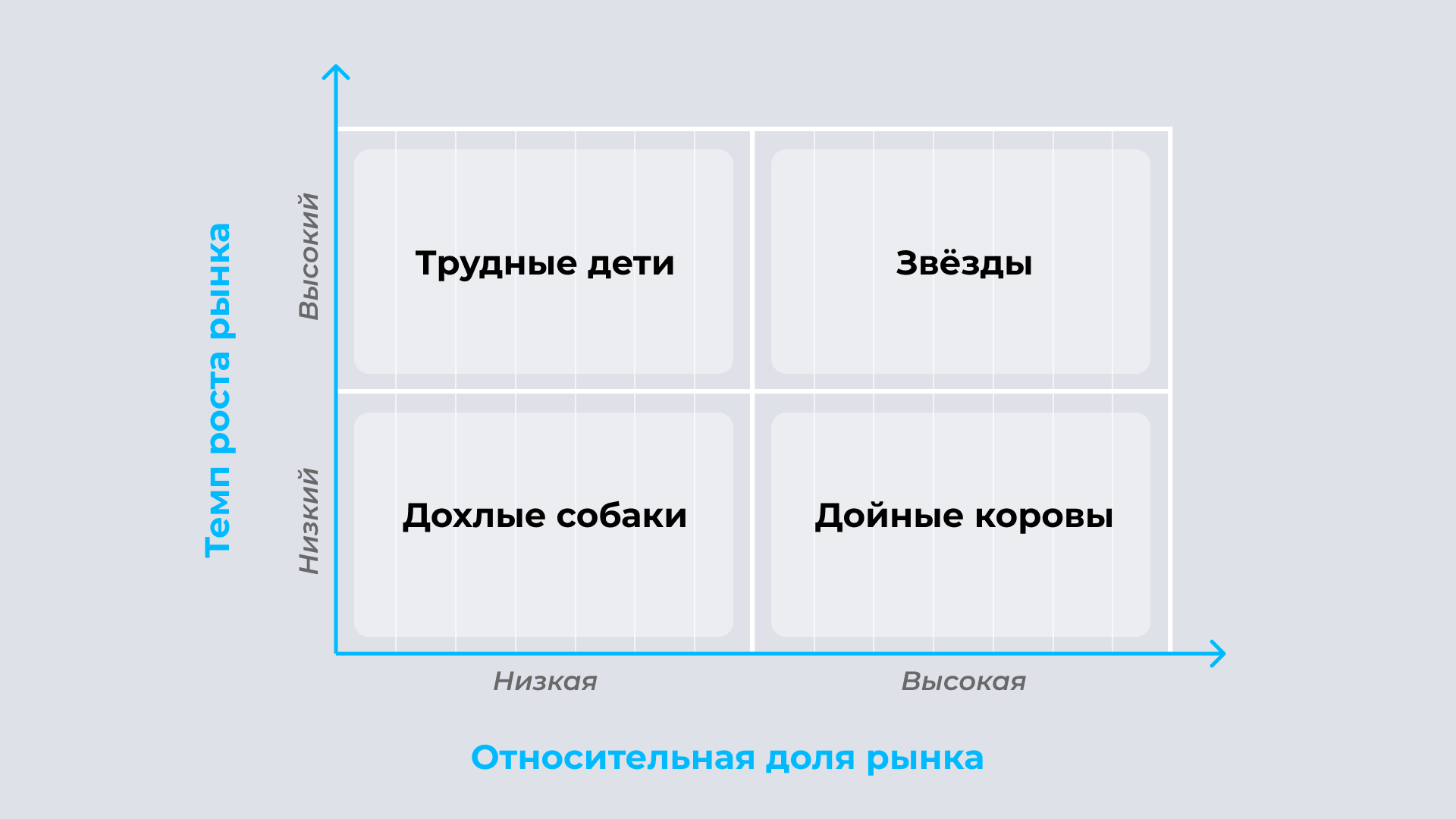
The Boston Consulting Group matrix
The matrix is divided into four sectors. Their names can vary, but the substance is the same:
- Problem children — troublesome products that require money to be put in but don’t bring the company profit yet, or bring very little. These products operate in growing markets and grow along with them.
- Stars — the products the portfolio is created to produce in the first place. They grow fast and hold a large share of the market. They’re the leaders of their market, they shape it, and so they’re expensive. Stars include promising products that require investment but will bring in a lot of money in future.
- Dead dogs — products with no clear prospects. Usually they’re self-sustaining, in a stagnating or falling market. They don’t hold a large market share and don’t help reach the company’s goals. They can hold development back by pulling company resources onto themselves, people above all.
- Cash cows — products that were once stars, and now that the market they’re in has slowed its growth, the company extracts money from them. Most often they have no growth prospects unless the target market is changed.
The matrix helps you manage products — make decisions about what to do with them. To do that, you distribute the products across each sector of the matrix. To work out where each of the products sits, you need to understand the size of the market the product operates in and your share of it.
In general terms a balanced portfolio looks roughly like this:
→ cash cows, out of which you extract the funds for the rest of the products;
→ product initiatives aimed at getting more stars into the portfolio. If the cows bring in enough money, you reinvest it into growing the stars;
→ problem children — products you invest in for the chance of winning a large share of a growing market;
→ dead dogs — the losers. A product ends up here because one of the hypotheses didn’t work. Maybe you counted on getting a large market share while it was growing and it didn’t happen, or the market moved into stagnation earlier than planned. These products have a low potential rating, and the only reason to keep them is the prospect of turning them into problem children — if the market starts growing, or the team moves to a different market.
The strategy of a portfolio like this is built around the stars. The company raises the chances of them appearing in several ways. For example, it funds the product and gives it scarce resources; it creates opportunities at the expense of other products by taking them apart into pieces — technologies, people and processes — and directing the resources to the stars.
If the market isn’t growing, the product will quickly turn into a dead dog
Don’t invest in a product if you don’t have a hypothesis about growth in the market where it’s going to operate.
There’s one heuristic that strikes me as universally useful: don’t invest in a product if you don’t have a hypothesis about growth in the market where it’s going to operate. The exception is when it isn’t a standalone product but a fragment of a big product that already operates in a growing market or holds a noticeable share of the market.
There’s a situation where a company works in a growing niche, but that niche sits inside a stagnating market. In that case it all comes down to a comparison: is the niche’s growth rate enough to beat the trend of the parent market. In other words, will the niche grow fast enough for the product to become a star in time.
Say a company enters a stagnating market with one growing niche, thinking that its products are problem children that can become stars. Things aren’t entirely smooth for these products, but their chances are good, because as the market grows their valuation will grow with it. But it turns out the market isn’t growing, and the problem children become dead dogs.
Then the question comes up: what is the company spending resources on them for, when the money and the people could be redirected to other products.
You can put money into dead dogs only if there’s a reliable hypothesis about how to get out of that position. For example, the company is confident that a trigger will occur in this market that will set off fast growth. But you definitely shouldn’t put money into a dead dog just because it pays for itself, with no prospect of the market changing.
Although from the team’s position there can be a conflict here. It doesn’t pay an investor to spend effort and scarce resources on maintaining a product that has no chance of turning into a future star or of helping the existing stars. For the product team it’s their baby, and it has value of its own. In that sense dead dogs are difficult for this reason as well: with them the chance that the investors’ goals and the team’s goals diverge is far higher.
In essence, portfolio management is a strategy in which the company tries to make stars out of problem children.

If the market is growing and the company understands that it can make the best product for that market, it forecasts the speed of the move from problem child to star. In essence, portfolio management is a strategy in which the company tries to make stars out of problem children. If that doesn’t work, they stop putting money into the problem children. If it does, the company keeps growing, managing to create new flagship products before the old ones lose their margin and their prospects.
I’ve looked at product management strategy in general terms and described the simplest instrument I know of. It doesn’t cover all the nuances, of course. But in practice, most of the strange decisions that have led to a loss of prospects happen because there simply was no coherent strategy.