How Do You Find Inspiration for Work in an Unconventional Way?
About why laughing a lot is the norm at the companies where I'm the director. And what other unconventional ways there are to draw inspiration for work and stay creative and productive.
I have a few recipes.
First — the simplest and most reliable one.
Honestly, I think every IT person ought to use it, although I’m often told that in this respect we’re more extreme idiots than our colleagues. If I worked at a bank, I’d call this method “a sense of humour”. But actually it’s called “guffawing”, or “laughing yourself a fat mug”. Or something along those lines. In short, you have to arrange things so that people laugh loudly and, preferably, often.
Sometimes it seems to me that if it weren’t for laughter, I’d have dropped the whole thing. Laughter helps especially during a crunch, or under some serious pressure or overload. Your mood changes in one jerk: a moment ago you were sure you had almost no strength left, and then one of your colleagues cracks a joke during a meeting, the others pick it up, and I can literally feel that something high-octane has been poured into me — I’ve got something to drive on.
The problem here is that joking to order doesn’t help. So you have to arrange things so that people rib each other good-naturedly (and me, me too!). That’s why at the companies where I’m the director, guffawing is the norm. I wouldn’t say we do it on purpose, but we have plenty of occasions for it:
- There are several Slack channels that exist specifically for laughter. The joy of it is that local traditions start up in them, memes that live a very short time — but they’re our own homegrown internal memes;
- Everyone can make jokes about everyone, no matter who you are — CEO or the most junior intern. One exception: the client can’t be the target of the jokes (unless the client started it). But colleagues, internal processes — as much as you like.
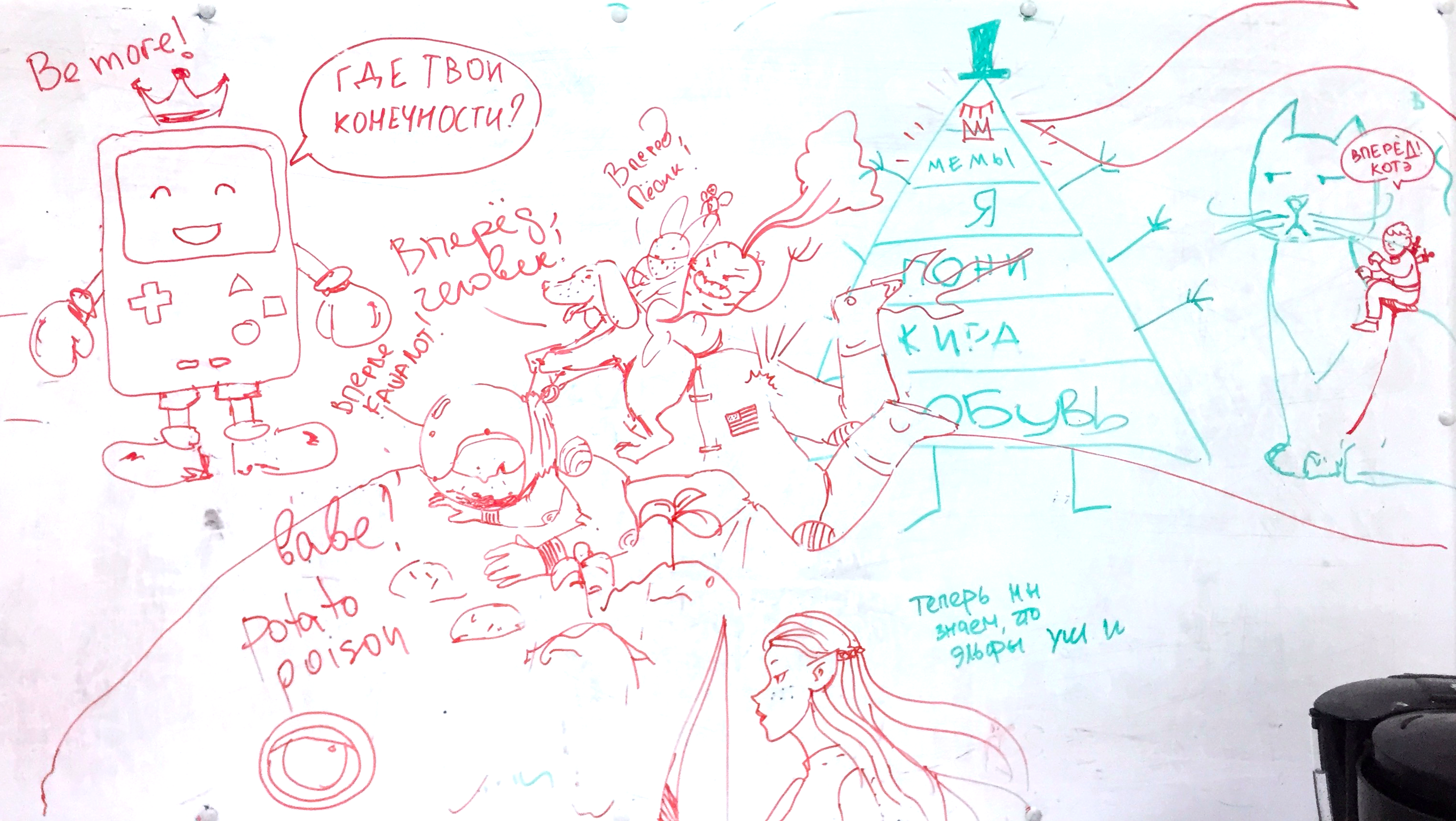
- In our kitchen we have a whiteboard whose only purpose is graffiti. From time to time a long, sprawling discussion in pictures unfolds on it. It looks roughly like this:
Secondly, I have role-playing games.
I’ve been doing them for — it’s frightening to think — 25 years. Over that time I’ve decided several times that I’d had enough of this (epithets here). But then it would get through to me how much creating games and taking part in them gives me. I don’t think it’s a universal recipe — but I’ve learned to extract new experience, good new questions and energy out of a role-playing game. Even though a trip out to a game usually means several days without sleep, in the woods, at a high emotional temperature — when you get home the adrenaline drops, and at first it feels as if someone has switched off the lightbulb inside you. But then, over the following couple of months, new questions start surfacing in me — I realise I’m interested in some new obsessions again, I want to solve the problems that have piled up, ideas and projects start appearing in me. In short, what happens is the exact opposite of a midlife crisis.
But what helps me most is a format we came up with as an alternative to role-playing conferences — the Role-Playing Methodology Camp. It’s a format of joint extreme creativity. Four days during which we set a problem, develop several new games, run them right there on the spot, and work out which of the methods we’ve found can be used later on. It’s most like a hackathon, only with far more going on and about games. Our friends who come to RML often complain that we “use deprivation by lack of sleep” — because those days contain very, very much joint creativity and very little rest. But after RML I discover every time that I’ve been given a technical inspection, I’m alive again and I want to act.