AI for a LARP Game Master's Tasks
Today I'm going to talk about how to apply AI to a game master's tasks, and about what quality you can get and how. I'll share the ideas that have piled up and try to show how you can work with this.
Introduction:
Over the holidays I ran a masterclass on how to use neural networks in the work of a LARP developer. As you may know, I’ve been doing game facilitation since ‘91, and I find a lot in it that’s useful for working on products and businesses. So this time too I think the results may be useful not only for games.
Here it’s important to understand what we’re working with and what we expect from ourselves. For instance, some of you wrote in the questionnaire that you’d like more examples and specifics on text AI. Someone wants to understand how to build AI into a game. I’ve taken all your requests into account, and we’ll try to lean on them.
So, our goal is to figure out how to use AI tools effectively. We’ll be talking about role-playing games, not just about “universal AIs”. The point is how game masters and players can apply these things to make life simpler, work more efficient, and games more interesting.
AI suits any level. For beginners it will help sort out the basics, for the middle ones it will help put processes in order, and for advanced ones it gives more room for experiments and development. The whole question is exactly how you’re going to use it.
The main win from working with AI
The main improvement is a lower cost of iteration. You can make more attempts in the same time and with the same resources. Everything else follows from that.
Why this matters for role-playing games
The problem with traditional development:
- The game master team can run few experiments
- The main experiment is the game itself
- It eats a lot of resources
- Usually there’s only enough strength for one pass
What AI changes
Now you can:
- Generate lots of variants fast
- Throw out the weak ones
- Explore different directions
- Pick the best
An example from practice
When I can’t come up with an idea, I need a base to extrapolate from. AI helps:
- It quickly creates variants for inspiration
- It lets you see non-obvious connections
- It gives material for developing ideas
The result: instead of one attempt you make dozens. Instead of one direction you explore several. And most importantly — you can afford to make mistakes and experiment.
The main things you’ll need
- A concrete task
- You need to understand the type of task
- Define your role and the AI’s role
- Choose a suitable type of work
- A working method
- Without a method there’s no control
- You can’t work on quality
- AI can suggest options for methods
- But the choice stays with you
Method
You need a methodology — that’s the key to any process. When we work with AI, we need a clear plan for how we’re going to use the tools. Without it you’ll get chaos instead of a result. AI can propose options for methodologies, but choosing which one fits is your job.
An example of working with a methodology: Suppose you’re creating a character. Instead of just asking AI to “come up with a character”, you need to give it a concrete method. For example: “Take the Maki method” or “Use the Hero’s Diamond template”. The same with other tasks — from gameplay methods to the role gearwheel. It’s important that every task is backed by a structure.
Heuristic: — if a methodology works with students or juniors, then it will work with AI too. For example, if you’ve ever explained something to students, game facilitators, children or your mum, you know that you have to not only convey the information but also formulate it so that this someone gets a result. And if it worked with them, it will work with AI.
Examples of methodologies in action:
- Jurgen’s method of collecting banalities: First you ask the participants (or the AI) to generate a mass of basic ideas. Then you cross out everything obvious, give a refined template and repeat the process at a greater level of detail.
- Alisa’s decomposition method: You take a big task, split it into subtasks, add examples and references. After that the AI or the participants carry out each subtask separately.
These methodologies work both with people and with AI. There is a nuance, though: with AI it’s better not to give global tasks like “do everything at once”. The more the task is broken into stages, the better the result.
The key principle: formulate clear requirements and procedures, as if you were explaining the task to a person.
Roles in working with AI
Basic positions
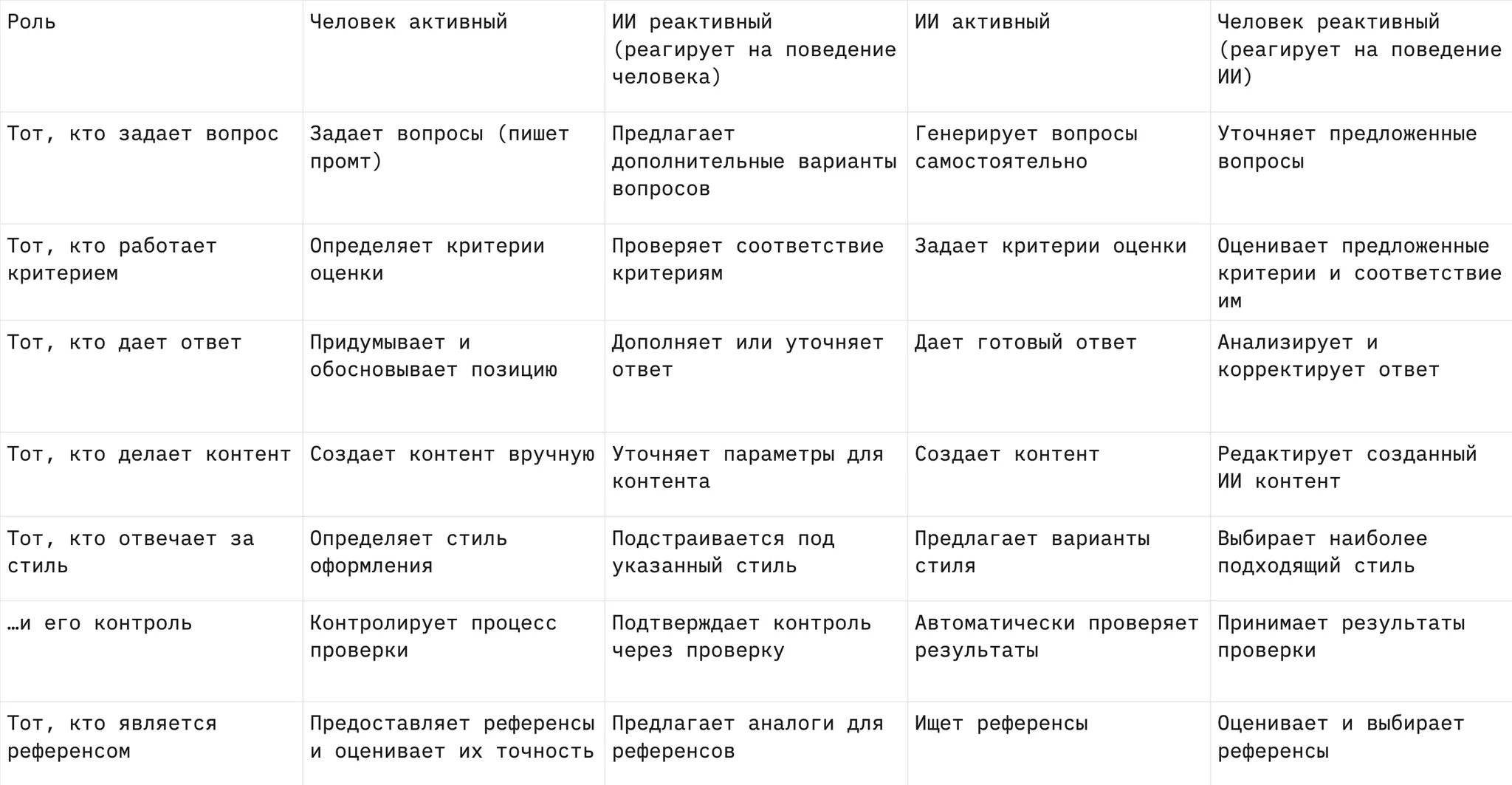
There’s a set of key roles:
- The one who asks questions
- The one who works with criteria
- The one who gives answers
- The one who creates content
- The one responsible for style
- The one who controls style
- The one who serves as a reference
The idea is that you can combine them any way you like. It doesn’t have to be the human giving orders and the machine doing them. For instance, one of my favourite modes is when the AI interviews me, following a methodology I’ve proposed, adding nothing of its own.
The principle of flexible roles
Forget the scheme “human = master, AI = servant”. Roles can and should be swapped:
- The standard scheme: the human asks, the AI answers
- The alternative: the AI asks questions, the human clarifies and analyses
- Any other distribution of roles is possible
Schemes for alternating roles
Available working patterns:
- The basic divergent–convergent cycle
- The HADI cycle
- “The Garden of Forking Paths” — multiple lines of development
Examples of working combinations
- Hypothesis:
- The human asks the question
- The AI proposes clarifications and examples
Action:
- The human creates the content
- The AI improves the style
Data:
- The human analyses the results
- The AI checks the data
Insights:
- The human draws conclusions
- The AI proposes analogies and hints
Active human + reactive AI:
- Hypothesis:
- The AI generates hypotheses
- The human corrects
Action:
- The AI creates the content
- The human refines the style
Data:
- The AI analyses the data
- The human picks out the key metrics
Insights:
- The AI formulates the conclusions
- The human evaluates and adapts
Important: Experiment with different distributions of roles to find the best option for a specific task.
The pipeline
To work with AI you need a pipeline — a sequence of steps where each stage is clearly divided between the human and the AI. This interaction is built like “ping-pong”: you do something and pass the ball, the machine picks it up, also does something and passes it back to you. The main goal is to use AI as a partner. More precisely, as a team of partners, with you in the role of the integrator — the one who builds the pipeline.
In reality, working with AI is always:
- A sequence of operations
- A passing game with the machine
- Alternating actions of human and AI
- Using different tools
An example of a pipeline:
Say I need to write a song for a game announcement.
Human: I form the theme. I think through the main ideas and collect interesting, non-banal associations. AI (ChatGPT): I ask it to propose additional associations, to refine and expand my set of ideas. At this stage it helps me look at the theme more broadly. Human: Based on the collected material I develop the basic structure of the verse. For example, I decide it’ll be something in the style of Mayakovsky. AI (Claude): I hand over the structure and ask it to shape it into a verse. Claude acts as the executor, framing my ideas as text. Human: I edit the resulting text by hand, adding individuality and smoothing out the rough spots. AI (Suno): I use it to create the first version of the melody. At this stage it offers a basic option. Human: I pick musical references to specify the style I want. AI (Suno): Taking the references into account, I generate the melody again, bringing it to its final version.
In short — it’s a passing game. You come up with the sequence of passes and decide what quality to reach and by what route, handing part of the operations to the AI.
Problems with the pipeline:
- Jumping between tools: For example, for styling text I use Claude, for structuring — ChatGPT, for music — Suno. Each tool is good in its own niche, but you have to switch a lot.
- A secretary, not a genius: The AI takes notes for you, offers options, structures things. And you define the method and help it put everything together so that it matches your intent.
- Iterations are tiring: Even with a good pipeline every step requires clarifications and repetitions. For example, the first melody from Suno has to be reworked several times to get the result you want.
Conclusion: AI is a tool that helps optimise the work process, but it demands a clear statement of atomic tasks. The better you know what you want and which methodology to use, the more productive the interaction becomes.
Tool specialisation
The principle: Each tool should solve a concrete task
- Don’t try to use one tool for everything
- Even with one tool (ChatGPT, for example) change its role
- Force the tool to be a specialist, not a generalist
Managing the process
For effective work you need to:
- Have a set of tools at hand
- Understand the strengths of each
- Be able to switch between them quickly
- Clearly define the task for each stage
The key point: Success depends not on the individual tools but on the ability to line their work up into a single chain.
The main tools
ChatGPT
Advantages:
- The most universal of the tools
- Good work with the Russian language
- Built-in DALL-E for generating images
- High availability (it doesn’t get full as fast as the others)
Limitations:
- It can produce false information
- Less precise on specialised tasks
- Limited context memory
Claude
Strengths:
- More cultured and precise
- Holds a literary style excellently
- Follows complex instructions better
Weaknesses:
- Gets “full” quickly (the limit runs out)
- More expensive because of less funding
- No work with images
Perplexity
Features:
- Works as an AI search engine
- Gives links to sources
- Produces false positives less often
- Can use different models under the hood (Claude, GPT-4, Grok)
Recommendation: if you can only pay for one tool — take Perplexity.
Midjourney
Capabilities:
- Image generation
- Working with styles
- Using references
Specifics of working with it:
- Requires precise prompts
- It’s important to use the stylisation parameters correctly
- You have to account for the specifics of the interface
Choosing tools
Principles of choice:
- Each tool can work differently for different tasks
- Don’t believe general recommendations without checking
- Test all the available options
- Choose for the specific tasks
Important: Tools are constantly developing and changing. What was best yesterday may fall behind today. Follow the updates and be ready to adapt.
Problems when working with AI
1. Precision drops with volume
If you’re trying to do something big in one piece:
- Write a whole novel
- Transcribe a two-hour session
- Build a database of larpers
the AI starts getting lazy and working imprecisely.
The solution: Break it into small pieces, make a plan, process it sequentially.
2. Difficulties reproducing styles
- The more widespread the style, the better it works
- Claude writes brilliantly in the manner of Brodsky, but doesn’t know Venya Dyrkin
- It knows the general things (Nordic) but doesn’t know the specifics (Russian role-playing games)
3. Memory is finite
- The context regularly gets clogged
- You have to make digests
- You need to reformulate things into compact lists
- Constantly clean up and structure
4. The banality of synthesis
Two opposite statements, both of them true:
1. AI is obviously banal.
Since it isn’t capable of sincerity or emotional experience, all the content it creates is either something it saw somewhere or the result of recombination. There can be no fundamentally new content. In that sense we’re not that different, but we can give our ideas a sincerity that makes them non-banal.
2. AI is incredibly creative.
In terms of erudition and recombination it beats us hands down. If you don’t try to treat it as a senior designer or game master, but instead set a clear methodology, it produces perfectly creative variants. But they require your choice and your finishing work.
Yes, AI is banal (in the sense that it isn’t sincere), but it’s still useful (because it can produce more combinations than we can). A creative pair of a human and an AI is stronger than a creative pair of two humans, because it’s faster — which means it will create more variants and can afford to filter harder. Just set clear methods and don’t expect it to do everything for you. It works excellently as a tool for collecting ideas and expanding possibilities, but the responsibility for assembling the result stays with the human.
The solution:
- Don’t try to use it as a senior, work with it like a junior: give it a concrete method
- Make lots of attempts, choose among the variants, throw out more
- The choice of the best variant stays with the human
5. Incompatibility of tools
- Claude is good on style but gets “full” quickly
- Perplexity is good at search but limited as a generator
- Different tools — different strengths
6. Routine repetitiveness
- You have to do the same operations over and over
- A lot of technical work
- Processes are hard to automate
7. Constant studying
- You can’t keep up with mastering the new capabilities
- Constant stress from what you haven’t studied
- A large volume of new information
8. The trust problem (false positive)
- You can’t trust it without checking
- It invents things that don’t exist
- It speaks confidently about things it doesn’t know
- You can’t always get reliable links