How Designers Give and Receive Feedback
About fifteen years ago I realized that an art director — a person who creates design through other people — does it through feedback. That's exactly what makes an art director different from a designer, and ever since it's been the central topic I care about.

About fifteen years ago I realized that an art director — a person who creates design through other people — does it through feedback. That’s exactly what makes an art director different from a designer. An art director has a different instrument — designers — and additional goals connected to their professional growth. Ever since, this has been the central topic I’m interested in.
Feedback is the main engineering skill

Things are constantly happening to us, we live our lives somehow, we speak at conferences, we do our work — events happen to us, we accumulate experience. If we understand what happened to us, if we take that experience in, make it ours and become aware of it, then we get better. Most people who know how to take ownership of experience learned it from somebody else.
Here’s what that path looks like when we’re training a designer
- We take an intern, teach them to receive feedback, and the moment they’ve learned to do it — we have a junior.
- We take the junior, spend about 2 years teaching them to give feedback, and bam — we’ve got an art director.
- Take any person at all, and if they can give feedback to themselves, they can make absolutely anything out of themselves.
That’s why I think feedback is the main engineering skill, and it’s what I keep trying to learn.
Feedback is my religion. I think it’s the most valuable thing you can focus your attention on, because it’s precisely what makes us better.
Good feedback unloads the cognitive channel.

Let me show you how a situation arises in which a person actually needs feedback. And for clarity I’ll start not with design but with a more motor skill — driving a car. The situation I find myself in as a driver repeats, one to one, the situation a beginner designer is in while mastering the basics of the profession.
I’m currently learning to drive a manual, and I’ve counted seven cognitive streams I have to process while my instructor and I drive around the city.
1. I have to switch on my thinking in order to move through space.
Every single time I think about which state to shift that thingy on the right into, and where to stick my foot. It’s not a motor skill yet — I’m spending cognitive resource, I have to strain my brain, my instrument is not yet an extension of me.
Besides, I’m not a fly, I don’t have spherical vision, I can’t look backward and forward at the same time.
So I need to:
2. look forward,
3. look back.
And, of course, keep up with reacting to the stream of events that comes flying at me from the environment (faster than I can handle yet).
4. I need to understand how other cars move along the road, how they change lanes.
This is a completely different way of thinking than I’m used to. I have to learn to predict the behavior of the other participants in the process, read small details of their behavior and change my own behavior. In short, I have to make them predictable for me and learn to be predictable for them.
5. On top of all that, there are road signs.
That’s a separate symbolic system, and it requires entirely different parts of the brain. You have to be able to interpret those signs, and quickly, and match them against everything you saw earlier.
6. Another channel of perception is people honking at me from behind.
That’s because I have, naturally, stopped at an intersection and I need to think. And a human is a single-tasking creature; at any given moment it can think about one thing. I’m standing at the intersection, I’ve stalled, I don’t know what to do — and then the seventh channel switches on.
7. That’s my instructor, of course, yapping away.
He wants to give me feedback in this situation — and I’ve got six cognitive channels loaded already, thank you very much, while I’m effective at working with about one.
But I have a good instructor. And here’s how you can tell: his feedback unloads my cognitive resource instead of loading it up. He says to me: “Calm down, don’t rush anywhere. We’ve already missed this light. Now turn on the hazards and switch off the ignition. You just stalled because you dropped the clutch.”
What did he do, from a learning point of view?
He gave me time to calm down and think, and he showed me:
- what I’m doing wrong right now;
- what mistakes I made (that is, how I got into the situation I’m in now);
- how to start doing it right, right now.
The faster the feedback comes, the easier it is to learn.

We run into difficulties simply by entering any new subject area. For example, I’ve never done generative design. God forbid I open up JavaScript and start learning it.
Then I’d have a question: what should I be paying attention to right now? What should the environment be? How do I check that everything’s okay? I’ve never written a line of JavaScript. I don’t know what to focus on. Which means that from then on I won’t understand what’s happening and how bad or good my attempt is. And by the way, I still have no answer to the question of what parrots this “good” and “bad” is supposed to be measured in.
Thank God, modern interfaces give feedback very fast. I don’t have to wait for the thing to render. And if I make a mistake, I see it right away. Speed of feedback matters enormously here — and it’s best to get it right after the action. The kind that says: “Here’s what came out.” That’s why non-professionals love WYSIWYG editors (what you see is what you get) so much — the moment you do something, you immediately see what it will look like in the end. You don’t have to unfold abstractions in your head and hold on to the link between the code and the abstractions that will tell you what the result will look like.
One of the most important things an art director does with a designer is shortening the feedback loop.
If there’s no art director, then the only way to find out the design is bad is when it fails to work. When it turns out in production that it doesn’t work that way. Several months pass before that. And most likely the feedback, if it happens at all, won’t reach the designer, and in the end they’ll learn nothing.
Once again — the designer never finds out whether their design was good. And they won’t change themselves as a designer in any way. The results of their experience don’t come back to them, which means they learn nothing.
Feedback is help in taking ownership of experience

There are different readings of feedback, but this is exactly how I read it — I’m only interested in feedback that helps a person take ownership of their experience.
What does “take ownership of experience” mean? Something happened to a person, they got experience — and we help them extract value from that situation, learn to do that action better, cope with the difficulties that arise in it.
Through feedback we help a person make the result of their actions their own.
Once more: the goal of feedback is to help a person extract value from what happened to them. Which means the only criterion of quality feedback is how far that feedback moved the person you’re giving it to toward their goals. And for that you have to know their goals, otherwise you can’t give good feedback at all.
And by the way, if you’re giving feedback to an intern or a junior, they most likely aren’t aware of their own goals, so first you need to agree on those goals and make sure they really are their goals and not ones you imposed on them. And then you can give them feedback.
If you’re very professional and know everything perfectly, if you’re far better skilled than they are and you give them excellent, high-quality feedback, but they didn’t take it and didn’t move toward their goals, then what you had wasn’t feedback, it was bullshit. That’s bad feedback, all your expertise notwithstanding. The student’s progress toward their goals is the only criterion.
How do we learn anything at all?
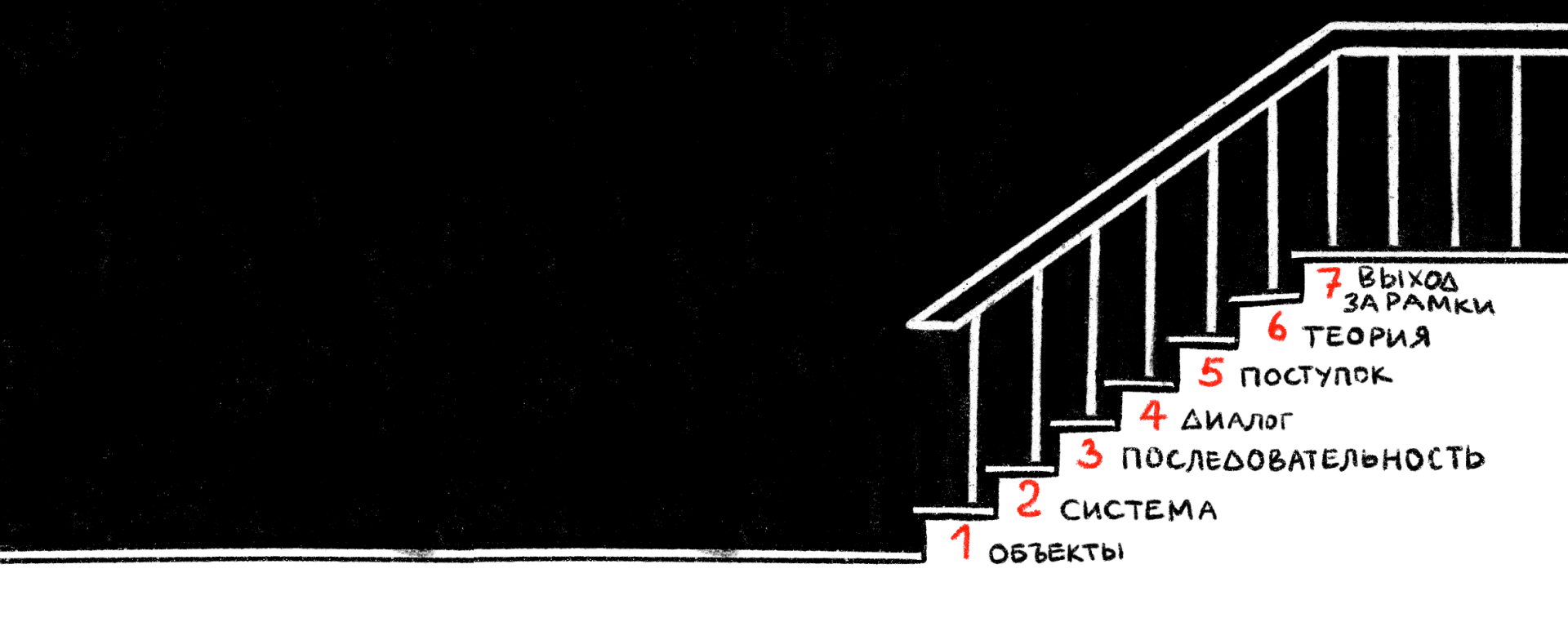
There’s a theory called “The Wanderers’ Ladder” — the sequence by which a person masters the subject area called life.
I learned about this scheme long ago, when Misha Kozharinov was teaching me to design role-playing games. It has 7 steps, let’s go through each one in detail.
1. Object
When a child is under three, they understand that there are objects in the world: an apple, a poop, mom, wallpaper. Just separate thingies.
2. Space
A child between three and six already understands that these separate things are somehow joined together in space. You can take an apple and drive it around the table. Or you can draw on the wall with poop. Then the object called mom will arrive, and something will happen. By the way, roughly at this time the child develops the idea of “I” — the point of view from which they look at all the other objects in space.
3. Sequence
At about 6–7 a child understands that there is such a thing as sequence — for example, if you smear porridge across the table, there’ll be no cake afterwards, because mom won’t give it to you. Porridge on the table = no cake.
4. Communication
At around 9–12 the category of communication becomes important to the child. They don’t just communicate — their attention gets fixed on how they’re building the dialogue. Communication becomes a value for them.
5. The Deed
Normally this stage is passed at about 14. We do something in such a way that the world notices us. Roughly speaking, all the boys know that I’m the one who broke the school window. And the teachers know about it too, but not quite the way the boys do — they only know it was done by some unknown hero. What matters is that we didn’t just do something. We did something the world noticed. That’s a serious disturbance. Kids at this age love throwing rocks so that there’s a big splash. By the way, doing something that astonishes everybody by way of destruction is the easiest path; very few people at this age can create something astonishing.
6. Theory
At about 18 a person starts producing generalizations of all this experience. They turn their gaze backward, and they get a theory that the whole world is arranged “like so.” At any rate, that’s what happened to me at 18 — I came up with a great many of these theories.
7. Paradox
A person understands that a theory is only a theory. It’s a certain model — and the whole world doesn’t fit into that theory. On the one hand the story is like this, on the other hand it’s different. For example, Zeno’s aporias — paradoxical propositions that contain contradictions within themselves, because the mental model isn’t the same as the world. Achilles will never catch up with the tortoise, because if you take their movement moment by moment, at each moment there’ll be a little bit more to go. But we do understand that in reality he’ll overtake her, right? And so we see two models, they contradict each other, and at this stage we enjoy finding such mismatches.
The Wanderers’ Ladder for a designer
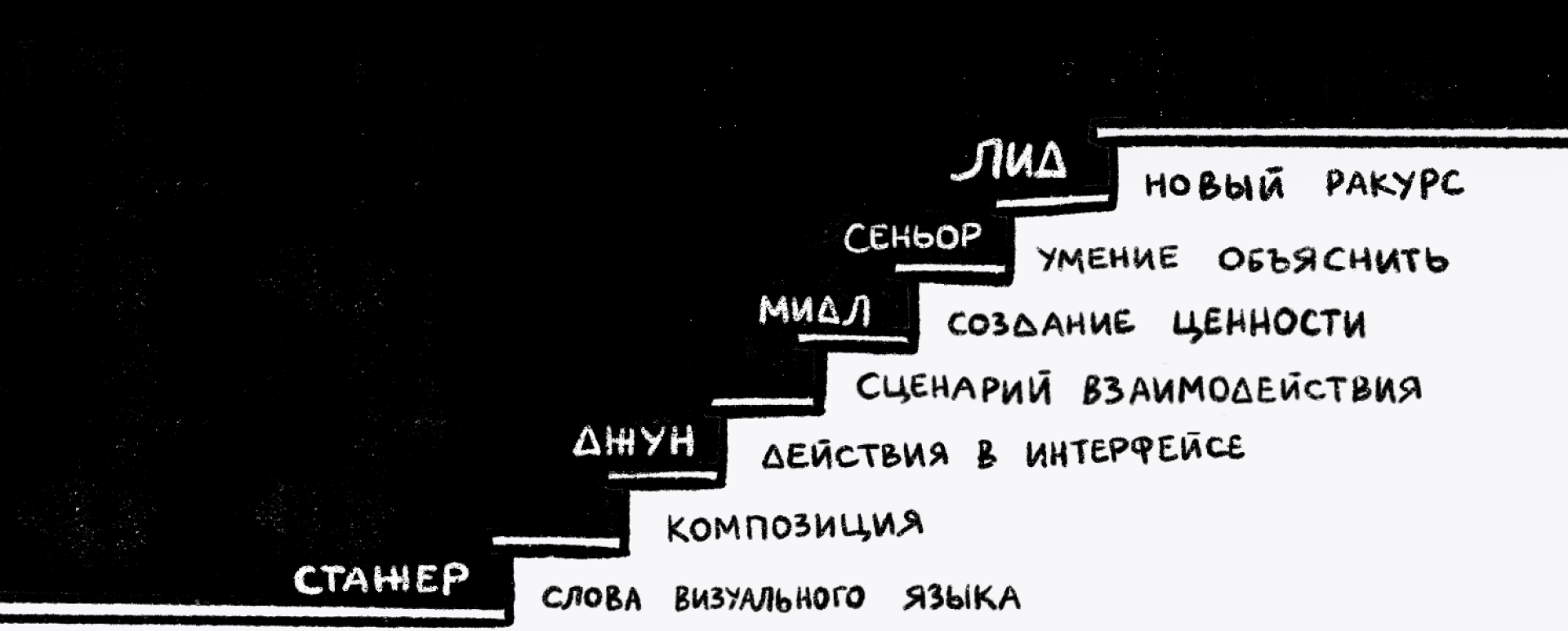
Depending on where the designer is on this “ladder,” their questions will be the corresponding ones.
1. Objects
What are these things — typefaces, contrast, buttons, layout? What bricks does this “Lego” have?
2. System
What’s the difference? Why are there typefaces with serifs and without? How do you look at them? How do they differ? And how do you combine them?
3. Sequence
In what order do I need to assemble the construction kit so that the separate “Lego” pieces we studied turn into a design?
4. Communication
By this point the designer has a visual language — they’ve understood what design is made of and how the pieces differ. Now they need to take the “Lego” instructions and learn to assemble the little airplane exactly the way the instructions say.
5. The Deed
Then the designer says to the art director: “I’ve figured out that you can build not a little airplane out of the Lego but an underwater elephant. I have my own reading of design. What do you think of my ideas? Come on, treat me as an equal, I’m a grown-up boy now.” And what they want to hear from the art director is: “Yes, kid, you’re seriously cool,” or even better: “Kid, you’ve surpassed me, I bow to you.” But usually the art director says something else, often the exact opposite. It’s very important at this stage to give room for that deed — so the person steps on the rake by themselves and, with an older comrade’s help, extracts experience from their (often unsuccessful) independent attempts. Even more important — that they get noticed and appreciated.
6. Theory
Once the designer has learned to create things that colleagues rate as “cool,” they can go further and say: “Great, I have a theory. The world of design works like this.” At that moment they start going to conferences and giving their first talks.
7. Paradox
“Everything isn’t the way I understood it. The way I understood design is only a part. Design doesn’t end at this level. There are other views on design.” For example, once upon a time I learned to do print design. And then I found out that there’s also interface design, and everything works differently again there. I learned interface design, and then discovered that no — that was just layout design, and there’s also the design of user scenarios. You can keep going forever: next comes the design of business models, processes and org structures, and those are already different professions. In short, over a career you’ll walk this little ladder several times. The first pass usually takes 3–4 years.
And every time you realize that everything isn’t like that. You realize you have to go back to the beginning, look at what other objects exist in that subject area, and go through all of it again. Each next time you walk the ladder anew, and from time to time you find yourself in the “look-at-me-I’ve-figured-it-all-out” state. I’ve been through the design ladder about four times myself.
On the diagram it looks roughly like this:
How, when, and what kind of feedback should you not give?
Together with colleagues I run a course for project mentors at UrFU and FEFU. I herd the participants (and all my acquaintances) into a survey. By the way, you can take it too, it’ll be useful to me.
It has 6 open questions, and there are no wrong answers. People write whatever they like — in what situation they need feedback, from whom and how they want to receive it. And the most interesting part: whom they don’t want to receive feedback from, how feedback should not be given, and in what situation they’re not ready to accept feedback.
I made half of the talk out of the answers to this survey; I learned an enormous amount from it and I keep using it. Here’s what I found out.
How should you not give feedback?
Below are quotes from the answers to the survey.
People say: “Please don’t give us feedback that isn’t objective. Without immersing yourself, aggressively, snobbishly and amateurishly.” By the way, amateurishness is a very frequent word in the survey answers. People also really don’t want feedback at the wrong moment, or in the form of “it’s all dreary shit.” They don’t want words like “fine” and “ok” if that’s the entire feedback (which, by the way, is what I do).

And now let me highlight in orange the feedback mistakes I make myself.

As a source of feedback, here are the unpopular things I do
I sometimes give advice instead of feedback — a common story with art directors. That’s when, instead of analyzing the situation the designer is in, you speak from the height of your experience and say that you shouldn’t do it this way at all, you should use this particular technique.
“You’ve got a mistake in the leading here, here’s a tip for you, take it,” — you say straight away, looking at the design, instead of analyzing it.
That is, you didn’t engage with the designer’s experience, you just pulled something out of your own experience and showed it to them. By the way, that’s not always bad — sometimes that’s exactly what a junior needs. But you have to ask yourself first: what will move the designer forward better right now? A ready-made technique or an analysis of their own actions? What goal are they heading toward at the moment? And what makes me think it’s that one?
Of course I give feedback at the wrong time, because I was walking past a designer, noticed something, and went: “Come on, show me what you’ve got here. Here’s some feedback for you, you’re welcome.”
A separate evil is value judgments. I try very hard to refrain from them, but I’ve handed out an assessment instead of feedback, and more than once. It’s very hard to hold back from value judgments when you’re looking at a design and want to say everything you think about it right now.
“Can’t be used in my situation, with my means”. What’s meant here is advice along the lines of: “Mice, become hedgehogs. How? No idea, my job is strategy.” Sometimes that can be held against me too, but I honestly try to show a technique that explains how exactly to do such a thing, out of the ones that work in my case.
Getting personal — I haven’t done that in a very long time (I hope), that mistake is from the really early days.
“You never,” “You always” — I swear outright that I won’t give feedback with words like that, but I have given it. And I’m afraid I’ll slip a few more times. Generalization is a very tenacious cognitive distortion. These are very harmful forms of feedback.
But there’s one very frequent word on this list that annoys everyone, and I’m not going to try to root it out.
I intend to keep giving feedback that isn’t objective. Because objective feedback doesn’t exist in nature at all — we’re all subjects. You just have to be aware that your position is subjective, and not pretend that what I’m saying is the truth.
When should you not give feedback?
Here everything’s clear — a lot of pain comes from people showing up at the wrong time. When there’s no time for this feedback of yours. Remember? Please don’t give me feedback while I’m standing at the intersection with all my channels overloaded.
And here’s what I’ll tell you. I’ve given feedback in every single one of those cases. When people were busy. When you can’t unmince the meat. At night. Right after the event. When everything around was shit. In each of those cases I was trying to help people take ownership of their experience, and sometimes I managed it.
And by the way, I don’t consider all of those cases unsuitable at all. People who say they don’t want feedback in certain situations mean roughly the following: “I don’t want you to make me strain my brain even harder when I’m already overloaded.” But actually I know how to give feedback in a way that makes things easier. So despite the fact that they don’t want it, I stick my nose in.

Let’s mark in green the cases where I consider myself entitled to keep giving feedback.
Under time trouble, and when the designer is busy, and when one of the parties is in the grip of strong emotion (that’s actually one of the most useful kinds of feedback, and that’s exactly when it should be given). I intend to give feedback when everything is already fine, and so on. Why? Because that experience is the most valuable one, and it’s precisely what mustn’t be lost.
But there’d be less green here if I were merely this person’s coach and not his boss. Let me show the words that are here because I’m his manager, and not just someone who cares about him becoming the best designer.

To make it clearer, let’s leave only those below.
So, despite the fact that this designer is uncomfortable right now, and it would be useful for his learning to let him spend the time and make the mistake, the manager gives him a direct instruction — how to change his behavior. Makes the decision for him, that is, sacrifices learning for the sake of the result.

So, there are two reasons to give a person feedback:
1. you want them to take ownership of their experience,
2. you need them to deliver a result.
If the result matters more than progress in development, feedback can and should be given under time trouble.
Whom are you not willing to accept feedback from?
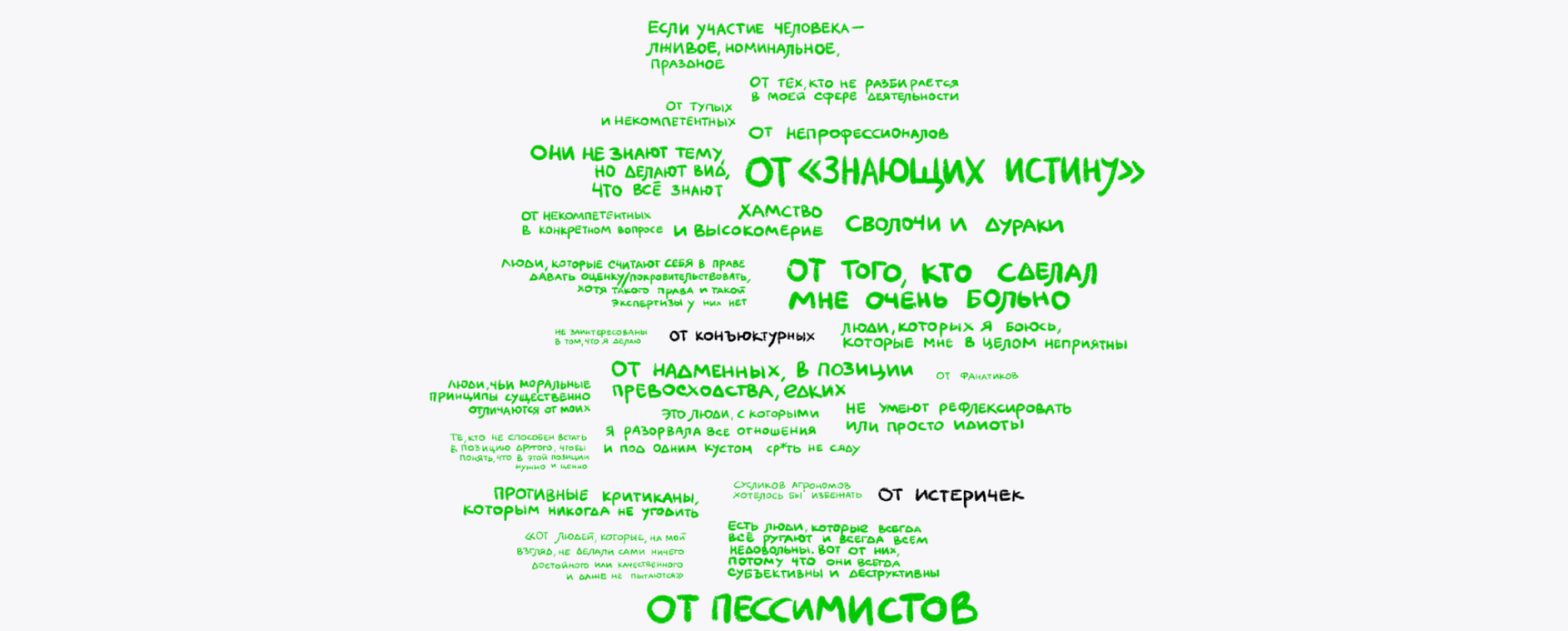
The most frequent answer — we don’t want it from “those who know the truth,” from “bastards” and “fools.” We don’t expect this exchange to move us forward. We’re not willing to count “that” as feedback.

For the record, everything in red annoys me too

And I myself try to be ready to accept feedback from everything in green.
But let’s go through it once more
Most often, in all of these cases we say we got feedback from an inadequate person. But inadequacy is our assessment, not some objective category.
This is the answer to the question of which position we’re not willing to accept feedback from. For example, when the person giving us feedback hasn’t been granted that right by us. Roughly like this:
You give me feedback, but you do it without respect.
For it to be otherwise, you have to sort out these 3 positions: feedback from the Elder, from Equals, from the Younger.
Which position is it better to give feedback from?
Equals
These are people who understand that objective feedback doesn’t exist, that we live inside a subjective picture of reality — that is, each of the participants is inadequate to reality to some degree and our pictures of the world diverge. If we’re adults, we ought to be able to synchronize our pictures of the world. That’s an effort we have to make together.
If we set aside the cases where you have different goals, or religiously different opinions about the path to a shared goal, then once you’ve removed the divergences in your pictures of the world everything will be fine. You’ll become a single collective subject and will go on understanding each other from half a word. That, in fact, is the target state of a team — when people can think through each other, share their thinking with the person next to them.

The Younger
The folks in the lower part of the “ladder” (remember? they haven’t mastered paradox yet) don’t know that there are other pictures of the world — ones unlike theirs. Until a person has settled into the level of paradox, they have one picture of the world — their own. If you tell them something that doesn’t fit into that picture of the world, they won’t accept your feedback, because you’re speaking heresy. Until they’ve moved into the upper part of the “ladder,” including in the subject area in question, they think your picture of the world is arranged the way theirs is. There’s only one.
If you want to give them feedback as the Elder, you have to act inside their picture of the world, because that’s the only place they’ll accept feedback from you. You have to understand what terms they use, what values they’re heading toward and what their goals are. And once you’re inside that picture of the world, you have to understand what mistakes they’re making in their terms, from the point of view of their goals. That is, to find the gaps in their picture of the world and talk about them in their language, in their interests.

The Elder
The Elder’s advantage is that they know how to reconstruct the Younger’s model of thinking. They can, in the Younger’s terms and starting from the Younger’s premises, discover and show the inconsistencies. They can understand how another person’s picture of the world is arranged, get inside it, and help solve problems within that picture of the world.
And, let’s say, an art director applies this not only to designers but to clients as well. The pace at which a designer enters the client’s picture of the world, and the speed at which they walk through the whole ladder, have to be very high for an art director. You need to be able to get into the client’s picture of the world in a couple of days, and better in a couple of hours.

Inadequate feedback: what kind, when and why
We call feedback inadequate when, for example, the Younger climbs into the position of the Boss with the words: “Right, now I’m going to tell you how it’s done properly. There’s my picture of the world, it’s the only one, and now you’re going to have the same one.”
Just in case, let me stress it once more. The Elder is a position in a dialogue, the ability to climb into someone else’s skin, to understand how your counterpart’s picture of the world is arranged. The Boss is a position in the administrative hierarchy. And problems arise when the Boss doesn’t know how to be the Elder and behaves as if he knows the truth and holds a monopoly on reality.
There are three situations in which that’s allowed:

Thank God, IT isn’t one of those three situations. And by the way, in all three of them it isn’t feedback (in the sense of help in taking ownership of experience), it’s simply fitting behavior to a template. We can’t afford that. First, the labor market won’t let us. And second, that way we won’t get middles and seniors who act independently.
Almost all communication problems run along the “kindergarten fight” pattern
Two very grown-up bosses who don’t know this whole story about equals talk like this:

The funniest part is that at that moment they think they’re behaving like adults.
How to give feedback when you’re the Elder
1. Get the right to give feedback, secure a request for feedback.
Most often it’s enough to ask for help. When you need someone to accept feedback from you, show them your problem. Often, when I need to do this, I say: “Listen, I have a problem with our design. Right now it doesn’t solve my problem, and I need to make the user actually want to go further. Help me.” In that sense I’m actually stepping into the Younger position.
2. Make sure you’re acting toward the goals of the person you’re giving feedback to, and that they acknowledge it.
If they don’t acknowledge that this action is really useful to them, this point doesn’t count. That is, you can’t say: “Seryozhenka, I know you have to put your little hat on.” That doesn’t mean at all that you’re acting toward his goals, mom.
3. Show that he matters to you.
Important! This point can’t be done insincerely. If you want to be able to give feedback, learn to feel emotions. One of the hardest skills of an art director is finding something to be glad about in the word “peace” written on the wall in poop. It’s important to genuinely find something to admire. By the way, this means that if the designer doesn’t matter to you, you won’t be able to be the Elder for him.
4. Understand which barrier he’s run into, show him a way through it and a place for the next step.
If a person has run into a barrier, it means he’s in a situation where he can’t just think on his own (use an already mastered skill) and has to reason instead (strain the mind). He’s forced to spend cognitive resource.
Our task here is this:
- to show him what the barrier is and how it works;
- to offer a technique that gets past the barrier;
- to watch how he applies that technique, and give feedback on that attempt, in order to help him judge how successful the attempt was and help him take ownership of the technique.
That is, to make it so that next time he doesn’t have to strain in such a situation — so that he can simply apply the technique.
The Boss ≠ the Elder.
You won’t manage to give good feedback by imposing your picture of the world unasked! If you want to give feedback — climb inside.
How to give feedback when you’re an Equal
The first three points are exactly the same:
-
Get the right to give feedback, secure a request for feedback.
-
Make sure you’re acting toward the goals of the person you’re giving feedback to, and that they acknowledge it.
-
Show that they matter to you.
And then:
-
Together you are a collective subject. That is, what matters isn’t how each of you acts but how you act together. So you have to show each other that you matter to each other.
-
After that, all that’s left is to work out what you’ve run into, where the boundary lies that’s stopping you from taking the next step — and to go together to the next rung of the “ladder.”
What to do if you’re the Younger
1. To get feedback, you have to ask for feedback.
“Mom, I can’t manage to write the word peace on the wall. What do I do?” Mom has just received a great deal of information, even though this was only a request for feedback.
2. You have to name your goals and make sure you’ve been understood.
If mom doesn’t understand what exactly you want to write on the wall, she won’t help you.
3. Show respect.
Otherwise you’ll get something that’s the exact opposite of what you need.
4. You have to name the barrier you’ve run into.
“The pencil broke” or “I don’t know how to write the word peace.” And ask to be moved where you want to be moved — otherwise you’ll be moved somewhere else.
The Younger is an ultimately strong position.
For example, here’s a girl who wants to get something from a young man, and right now he’s in this position: “Damn, I’ll have to behave like an adult, speak in her terms, move toward her goals. And why? Because she let go of her ego and stepped into the Younger.” That’s the only kind of feedback you can effectively give unasked.
If you’re the Boss, you’re forced to work from the Elder, which means you’re doing it with the Younger’s permission. Only the Younger can do it unasked.

To give feedback or not? 4 situations.
I have a simple scheme, and you’ll orient yourself by it easily.
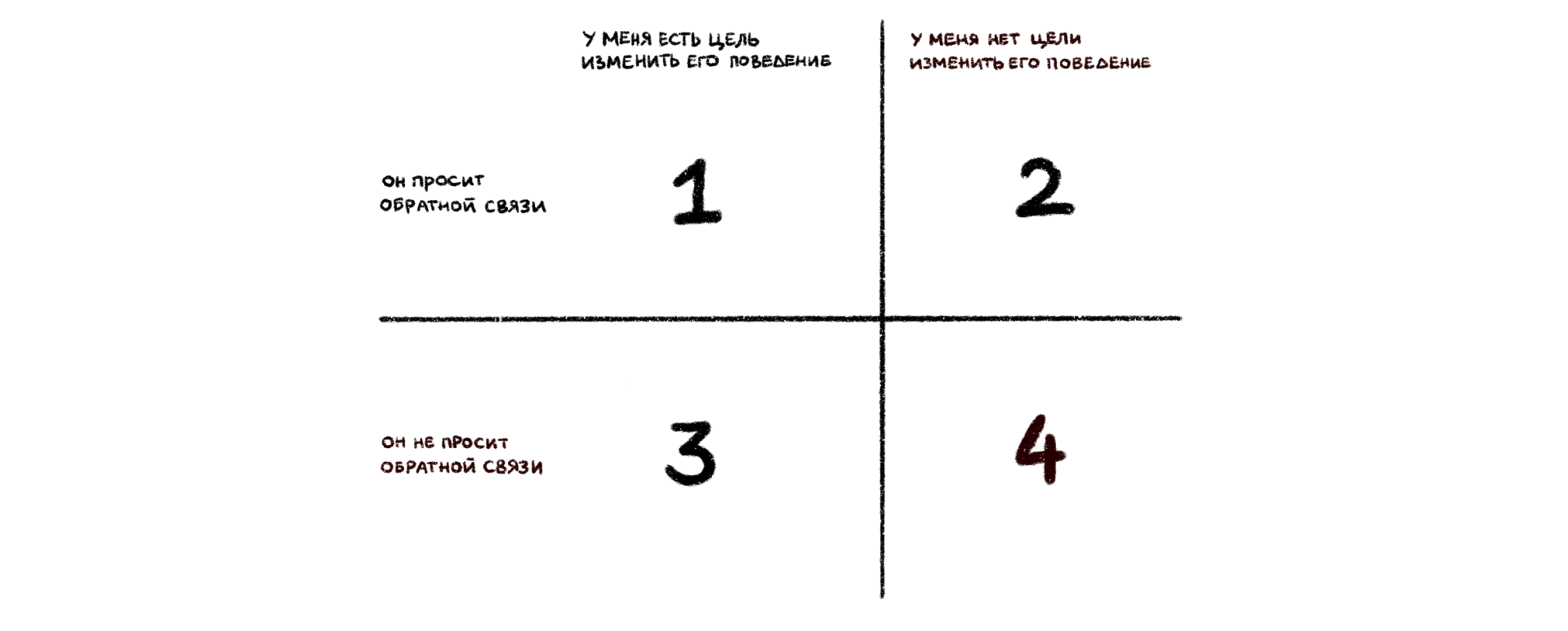
1 — If we have a goal of changing his behavior and he’s asking for feedback, then we simply have to be useful. We have to understand what his goals are and move him toward them. Besides, he asked for it himself.
2 — If we have no goal of changing his behavior, but he’s asking for feedback, it’s also simple: if you feel compassion for him, if he matters to you as a human being, you can give him feedback. A very important piece of knowledge — you’re not obliged to give him feedback. You only do it if he matters to you as a person. If he doesn’t matter to you as a person, don’t give feedback, nothing useful will come of it.
3 — If he isn’t asking for feedback, but it’s important to us to change his behavior (this is very often the case, especially when you’re a manager), then in order to give feedback you have to organize the request. (See “How to give feedback when you’re the Elder.”) By the way, this is the main idea of the whole scheme.
4 — If he isn’t asking for feedback and we have no goal of changing his behavior — this is where people give feedback most often. More precisely, this is where people most often speak up thinking they’re giving feedback. But it isn’t feedback. Here they speak up because “someone on the internet is wrong.” They aren’t trying to move the person toward his goals, they aren’t trying to give good feedback — they’re trying to assert themselves. They know the truth and want everybody else to know that truth. Nothing useful will come of it, you just shouldn’t say anything.
Not every argument is feedback.
Feedback is when you return information about his experience to a person, and what interests you is not the truth but how he’ll move forward relative to his experience.
About “amateurs” and “experts”
Most often you give feedback because somebody came to you for advice, which means they don’t consider you an amateur — they think you have expertise. But that still doesn’t mean you’ve been allowed to broadcast on behalf of the highest truth. The fact that you have expertise doesn’t mean you don’t make mistakes. So in this case too it’s worth speaking from the position of an Equal.
I have to say, I generally consider “expertise” a harmful concept. If I think I’m giving feedback as an expert, I’ll most likely fall into a cognitive error — because I’ll be defending my authority as an expert. I’ll try to impose my picture of the world on the person, and that won’t move him forward relative to his experience. Don’t do that.
The most effective mental technique I have is to stay a beginner.
Every time I run into a subject area or a word I don’t know, I say straight out: “I don’t know.” Even though it can lower my authority. It’s very cool to be able to hold the situation while talking to someone and try to become an Equal with them.
You always have to be ready for the possibility that you’re wrong. And to act that way you have to assume that you don’t know everything, and not try to argue on the grounds of “Seryoga, I’ve been doing UX for 25 years, so trust me.” That’s not feedback. Even though I really have been doing it for 25 years, it doesn’t improve the quality of my statement in any way.
By the way, I don’t think I’m a “feedback guru,” and if you have something to teach me, welcome! Write to me at kulakov@gmail.com.
Let’s collect feedback techniques together
I have one more survey — about the feedback techniques you use in life. If you have a favorite one, write about it in more detail. Or take a look at my collection.